By Amol Shewale, Assistant Director, CYDA
Most conversations about disability-inclusive urban development focus on public infrastructure and accessibility. We talk about street-level modifications, accessible government buildings, and retrofitting transport hubs. However, national macro-level data reminds us that for millions of Divyangjan (Persons with Disabilities) across India, the most immediate barrier to a life of independence is not the lack of a public ramp—it is the everyday struggle to access fundamental Water, Sanitation, and Hygiene (WASH) services within their own immediate and domestic environments.
To build an environment where inclusion is a lived experience, we must look beyond public sidewalks and address the intersection of infrastructure, social dynamics, and human dignity.
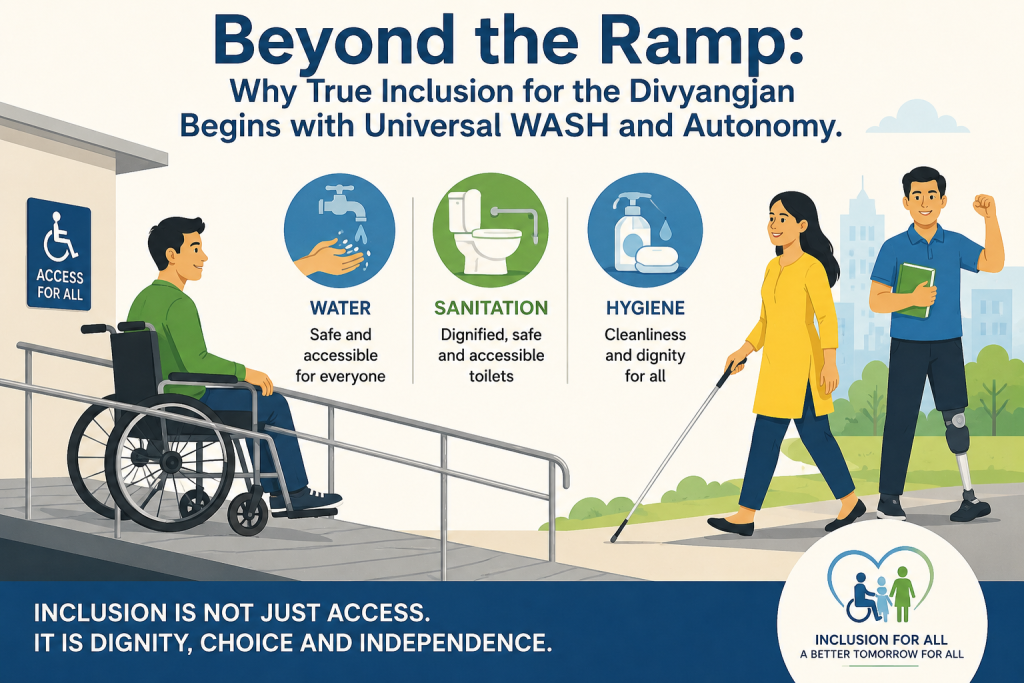
1. The Core Challenge: Access vs. Autonomy in WASH
A critical gap often exists between the nominal availability of a facility and its actual usability for an individual with a disability. National benchmarks—including the National Sample Survey (NSS) 76th round, which evaluated Drinking Water, Sanitation, Hygiene and Housing Condition alongside Persons with Disabilities—remind us that physical accessibility remains a determining factor in overall living standards.
- The Illusion of Close Sources: A household or community may feature a piped water supply or close-proximity water points on paper. Yet, structural hurdles such as high tap placements, uneven pathways, and narrow corridors mean that fetching water independently remains a persistent challenge for individuals with mobility or visual impairments.
- The Dignity Gap in Sanitation: Even when indoor or localized sanitation blocks are available, a significant proportion of traditional configurations lack essential support structures like wall-mounted grab bars, raised toilet seats, or non-slip flooring. According to NSS macro-data trends, the absence of assistive features leads to heavy reliance on external human assistance for basic daily routines.
- The Handwashing Bottleneck: Traditional handwashing stations are rarely optimized for varying heights or limited manual dexterity, turning a foundational hygienic practice into a routine that requires external assistance.
When a person must rely on a caregiver for basic biological needs and hydration, infrastructure fails to support personal autonomy. True inclusion requires moving past baseline metrics of “coverage” to measure how independently a facility can be used by everyone.
2. The Compounding Weight of Stigma and Awareness Gaps
Physical barriers do not exist in isolation; they intersect with deeply rooted social dynamics. Across both urban and rural setups, Divyangjan frequently navigate a complex landscape of community perceptions. While many experience supportive environments, a considerable number continue to encounter subtle social barriers, communication gaps, or attitudes rooted in pity and sympathy rather than an acknowledgement of equal rights.
This social friction is often exacerbated by a lack of institutionalized awareness. National survey insights indicate that a major portion of families and immediate community circles have never had access to structured training on disability inclusion—with the NSS 76th round highlighting that as high as 76.4% of PwDs do not receive any systematic institutional or organizational support. Without localized capacity-building, caregivers and neighbors are left to navigate complex behavioral, physical, and sensory needs without a clear support framework. Reducing social stigma requires deliberate, community-led sensitization that shifts the public perspective from charity to capability.
3. The Broken Pipeline: Education, Dropouts, and the Skilling Imperative
When basic water and sanitation needs are difficult to meet, a domino effect ripples through an individual’s life, beginning with early education. Physical infrastructure gaps in schools—such as inaccessible school toilets, stairs without handrails, and a shortage of adapted learning materials—force many children with disabilities to attend irregularly or drop out entirely. Financial constraints and health vulnerabilities further interrupt this educational pipeline.
THE CYCLE OF EXCLUSION
According to the NSS 76th round survey data, among persons with disabilities between the ages of 3 to 35 years, only 62.9% were enrolled in ordinary schools. This structural drop-off leaves a massive section of the population without foundational qualifications.
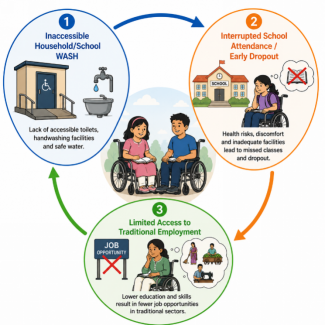
This early educational exclusion leads directly to low economic participation in adulthood, where the Labour Force Participation Rate among PwDs over 15 years stands at just 23.8%.
To break this cycle, the focus must shift aggressively toward adaptive vocational training, livelihood pathways, and upgradation of WASH infrastructure. National initiatives, such as the PM-DAKSH (Divyang Skill Development and Rehabilitation Scheme), highlight the vital necessity of training Divyangjan in multi-skilling trades. By coupling accessible classroom infrastructure with targeted skill development, we can equip individuals to transition into secure, dignified, and self-reliant livelihoods.
A Forward-Looking Framework: From Infrastructure to Independence
The Rights of Persons with Disabilities (RPWD) Act, 2016, and the Accessible India Campaign (Sugamya Bharat Abhiyan) provide robust legal mandates for creating universal, barrier-free environments. However, translating these frameworks into reality requires programmatic shifts on the ground:
I. Institutionalizing Universal Design in WASH
Water, sanitation, and hygiene initiatives must embed disability-inclusive designs from inception. This means ensuring all public and domestic sanitation blocks include wide doorways, grab bars, adapted commodes, and lowered tap heights as standard specifications rather than afterthought retrofits.
II. Integrated Skilling and Career Pathways
Educational and vocational institutions must be structurally and instructionally retrofitted. We must scale up technical and soft-skill training programs tailored to market demands, ensuring that Divyangjan have the resources and accessible environments necessary to participate in the formal economy. A key structural intervention can be the WASH Mitra initiative, explicitly designed to empower and train Persons with Disabilities in multi-skilled technical trades—including plumbing, electrical repair, carpentry, painting, water filter maintenance, and solar installations. By equipping individuals with these localized, high-demand technical skill sets, we transform them from passive recipients of aid into independent, professional service providers who actively maintain their community’s infrastructure.
III. Community Capacity-Building
Civil society and local governing bodies must invest in formal training sessions for caregivers, community leaders, and local contractors. Promoting a localized understanding of assistive care and technical retrofitting creates a sustainable support system that reduces individual caregiver burnout.
True barrier-free access is not an administrative checkbox or a slogan; it is the fundamental baseline for human dignity, safety, and self-worth. When individuals are restricted by their physical environment from accessing clean water, using a toilet independently, or acquiring economic skills, societal progress remains incomplete. By centering development strategies on accessible WASH infrastructure, inclusive learning, and robust vocational skilling, we can build an ecosystem where independence is a universal right.
References:
- NSS 76th Round Disability Survey Key Findings: Press Information Bureau (PIB) Official Release
- Ministry of Statistics and Programme Implementation (MoSPI): MoSPI esankhyiki Portal
- Department of Empowerment of Persons with Disabilities (DEPwD): DEPwD Official Government Website
