By Dr. Nitin Jadhav, Joint Director, CYDA
We live in an era of technology where ideas and concepts quickly become reality. Today, people are open to innovation, discussion, and change. Yet there is still one topic that remains ignored despite being a natural biological process. Menstruation. Many people still hesitate to talk about it openly. When conversations around menstruation are avoided, discussions on menstrual management at the policy, institutional, community, and family levels also remain limited. This article highlights the evolution of menstrual management and the policy changes introduced at both national and state levels. It also discusses the existing gaps in menstrual management and the importance of sustainable menstrual practices.
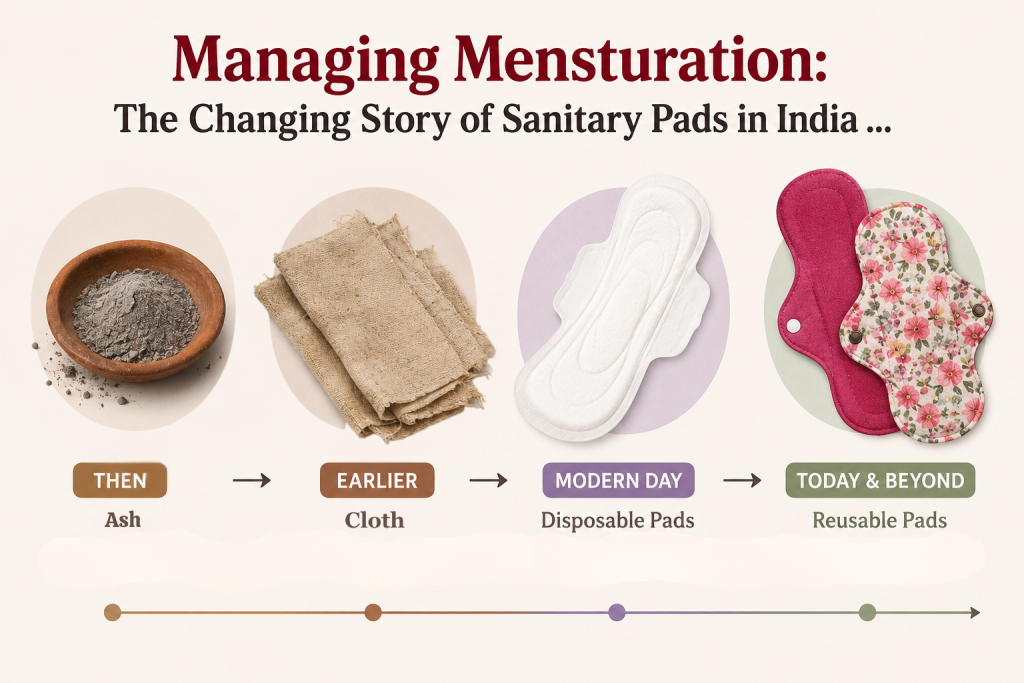
Menstruation in India is not just a biological process; it is a mirror reflecting social norms, economic inequality, access to health, and environmental responsibility. The evolution of menstrual absorbents, from cloth and ash to disposable sanitary pads and emerging sustainable alternatives, is not merely a story of product adoption. It is a story shaped by caste, class, geography, policy, and the persistent stigma surrounding women’s bodies. As India marks Menstrual Hygiene Day 2026, progress is evident, but so are deep, unresolved gaps.
A quiet past: Cloth, ash and silence
Reports by WaterAid India and the Menstrual Health Alliance of India document that before the expansion of commercial pads, Indian women commonly used old cloth, rags, ash, sand, and natural absorbents, especially in rural areas with limited market access and strong menstrual taboos. Even today, over 22% of young women aged 15-24 rely exclusively on unhygienic methods, while another 27% use a mix of hygienic and unhygienic materials, largely due to poverty, lack of access, and social norms.
Cloth itself is not unsafe if washed properly and dried in sunlight. However, stigma often forces women to dry menstrual cloth indoors or in hidden, damp spaces. Studies using National Family Health Survey (NFHS‑5) data show that lack of toilets, water, and privacy is strongly associated with continued use of unhygienic methods, particularly in rural and low‑income households.
Yet disparities persist:
- About 70% of urban women use sanitary pads, compared to only 48% in rural areas.
- Education matters: nearly 90% of women with 12 or more years of schooling use pads, compared to less than 40% among women with no formal education.
- In many rural regions, only around 16% of women have consistent access to sanitary pads, as reflected in public health reporting linked to WHO assessments.
Pads have symbolised “modern” and “clean” menstruation, but they have also introduced new challenges.
Health beyond the product
While sanitary pads can reduce some infection risks when used correctly, lack of awareness remains a concern. Medical studies indicate that women using unhygienic or improperly managed absorbents report higher rates of vaginal discharge and menstrual discomfort, particularly among socio‑economically marginalized groups. Changing a pad every 4–6 hours, ensuring access to clean toilets, and safely disposing of used products are as important as the product itself—yet these conditions are far from universal.
Education interrupted: The cost to girls.
Menstrual hygiene is directly linked to girls’ education in India. Multiple studies across Indian cities and states show that 30-40% of adolescent girls miss at least one school day during menstruation, mainly due to pain, fear of leakage, lack of toilets, or absence of disposal facilities. Girls who rely on cloth are three times more likely to be absent from school than those who use sanitary pads. National estimates suggest that millions of girls experience frequent absenteeism or drop out of school entirely each year due to unmanaged menstruation and period poverty, reinforcing cycles of gender inequality.
The environmental cost of convenience
Perhaps the most overlooked aspect of India’s pad revolution is its environmental impact. India generates an estimated 12 billion disposable sanitary pads annually, producing over 110,000 tonnes of menstrual waste every year. Most commercial pads contain plastic and super‑absorbent polymers, with a single pad taking 500-800 years to decompose. According to the Menstrual Health Alliance of India, around one billion used pads are discarded every month, often without safe segregation, endangering sanitation workers and polluting soil and water.
Government Action on Menstrual Hygiene: Progress and Limits
Over the past decade, menstrual hygiene has gained policy attention at both the national and state levels in India. The Government of India (GoI), through initiatives such as the Menstrual Hygiene Scheme (MHS) under the National Health Mission, has focused on improving access to sanitary products and awareness among adolescent girls, particularly in rural areas. These efforts have contributed to a measurable rise in hygienic menstrual product use—from 41.8% in 2015-16 to over 64% by 2019-21 among women aged 15-24, according to National Family Health Survey data. School‑linked programs under RKSK, Samagra Shiksha, and Swachh Bharat–Swachh Vidyalaya have further supported this shift by combining pad distribution with girls’ toilets and health education.
State governments have supplemented national schemes with their own initiatives. Tamil Nadu pioneered free sanitary napkin distribution as early as 2011, while states such as Kerala, Maharashtra, Rajasthan, Bihar, and Chhattisgarh have implemented pad distribution, adolescent health programs, and women‑led production through self‑help groups. Evidence suggests that states with sustained government support have seen faster increases in hygienic product use over time.
However, these efforts face persistent limitations. Despite policy expansion, over one‑fifth of young women still rely exclusively on unhygienic methods, and school studies show that 30–40% of adolescent girls miss at least one school day during menstruation, largely due to inadequate toilets, water, privacy, or disposal facilities. Most schemes remain product‑centric, offering limited guidance on correct usage, sustainability, or waste management. This is critical given that India discards around 12 billion disposable sanitary pads annually, generating significant plastic waste with weak enforcement of disposal guidelines.
In sum, government initiatives have clearly improved access and visibility of menstrual hygiene, but their impact is constrained by uneven implementation, infrastructure gaps, and an overemphasis on distribution over education and sustainability.
Addressing these limitations requires closer collaboration with community‑based and women‑led organisations, and a shift from counting products distributed to ensuring long‑term menstrual health, dignity, and environmental responsibility.
IMPACT IN ACTION: CYDA & the 10 Stitch Group, an eco‑friendly sanitary pads production initiative
To address both unsafe menstrual practices and the environmental impact of disposable pads, the Centre for Youth Development Activities (CYDA) initiated an eco‑friendly sanitary pad production unit in partnership with the 10 Stitch Group, a women‑led collective.
The initiative trains local women to manufacture low‑cost, eco‑friendly sanitary pads, reducing dependence on plastic‑heavy commercial products while creating sustainable livelihoods. By decentralising production, the programme ensures that menstrual products remain affordable, accessible, and culturally acceptable, especially for women and girls from marginalised communities.
Beyond production, CYDA integrates menstrual health education into the initiative—breaking taboos, promoting correct usage, and encouraging informed choice. The 10 Stitch Group members emerge not only as producers but as community ambassadors for menstrual dignity and environmental responsibility.
Together, CYDA and the 10 Stitch Group demonstrate how menstrual health, sustainability, and women’s empowerment can move forward, stitch by stitch, pad by pad.
Menstrual Hygiene Day 2026: From Products to Power
As India marks Menstrual Hygiene Day 2026, the conversation must shift from “pads for women” to “power for menstruators”. The evolution of sanitary pads tells us we have moved—but also that we still have far to go.
Menstrual health is not a luxury. It is not a woman’s issue alone. It is a matter of equity, environment, dignity, and justice. And the next phase of this evolution must be led not just by innovation, but by listening to the lived experiences of Indian women and girls themselves.
