Jyotsna Bahirat, Research Scholar
Menstrual hygiene management is an essential part of women’s reproductive health. There is now greater awareness about Menstrual Hygiene Management in India through the efforts of NGOs, schools, and educational curricula that provide information on puberty-related changes. The menstruation management is somehow limited only to awareness at present and not moving towards the adoption of practices. It includes sustainable menstruation management, availability of clean and safe sanitary infrastructure, availability of water, and economic situation.
The petition filed by a social worker Dr. Jaya Thakur under Article 32 of the Constitution in public interest seeking appropriate directions to the respondents – the Union of India, the States and Union Territories respectively to ensure providing of (i) free sanitary pads to every female child studying between classes 6 & 12; and (ii) a separate toilet for females in all government aided and residential schools. Apart from this, certain other consequential reliefs have also been sought for in the public interest, including the maintenance of toilets and the spread of awareness programs.
The recent revolutionary judgement (2026) on the petition by the Supreme Court of India declared Menstrual health and hygiene a fundamental right under Article 21(Right to Life and Dignity) of the Constitution. The petition filed for menstrual health and hygiene sought to address the issue of the lack of menstrual hygiene management in schools across the country. The problem identified is two-fold: first, absenteeism, and secondly, completely dropping out of school due to a lack of MHM measures. Menstrual hygiene management has now emerged as a critical public health and social development issue in India.
The judgment focused on adolescents or school-going girls. For Right to Life judgments state that, “The right to life under Article 21 of the Constitution includes the right to menstrual health. Access to safe, effective, and affordable menstrual hygiene management measures helps a girl child attain the highest standard of sexual and reproductive health. The right to healthy reproductive life embraces the right to access education and information about sexual health.”
The following directions are given by the Supreme Court in the judgment:
To all states and union territories, to ensure that every government and private school in both urban and rural areas provide functional gender-segregated toilets with proper water supply, privacy, accessibility for children with disabilities, and handwashing facilities with soap and water.
The Court further directed that free oxo-biodegradable sanitary napkins should be available to girl students through vending machines or designated school authorities, and that schools should establish Menstrual Hygiene Management (MHM) corners equipped with spare uniforms, innerwear, disposable bags, and other emergency menstrual supplies. Schools were also instructed to provide safe and environmentally compliant sanitary waste disposal systems, including covered bins in every toilet.
To promote awareness and reduce stigma, NCERT and SCERT were directed to include menstrual health, puberty, and related health issues in school curricula, while teachers must be trained and sensitized to support menstruating students. The Court also ordered wide dissemination of information regarding sanitary napkin schemes and child helpline services. District Education Officers were directed to conduct regular inspections and collect anonymous student feedback to ensure accountability and compliance. The National Commission for Protection of Child Rights and State Commissions were asked to oversee implementation, and all governments were instructed to comply with these directions within three months, recognizing menstrual hygiene as essential to the dignity, health, and educational rights of girl children.
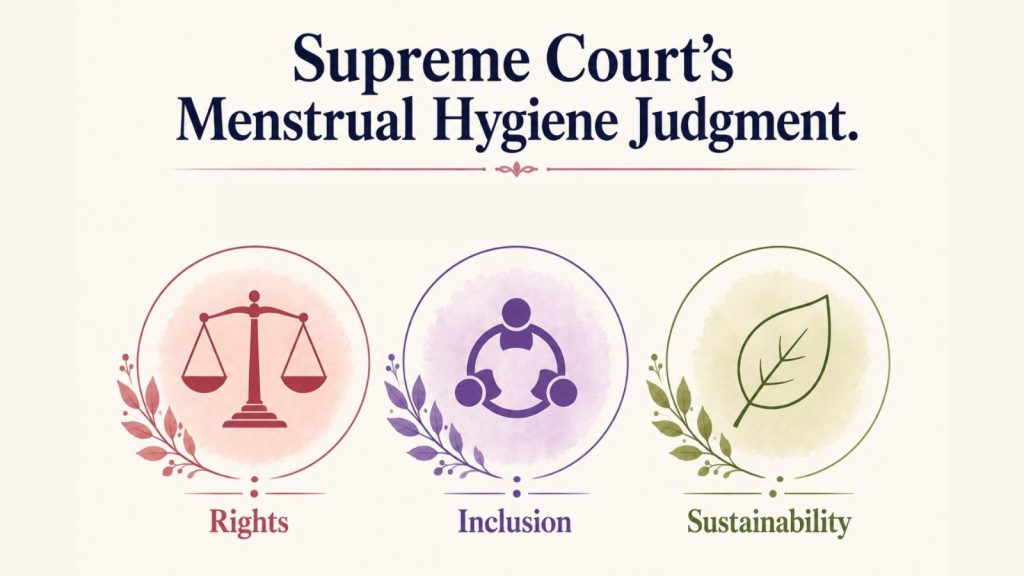
Discussion: The judgment makes a significant advancement in recognising menstrual hygiene as a matter of dignity, health, education, and fundamental rights of girl children. The Court approached menstrual hygiene as a public health concern linked with sanitation, infection prevention, reproductive health, and adolescent wellbeing. Directions regarding handwashing facilities, clean toilets, water availability, and safe disposal systems recognize that menstrual hygiene management requires comprehensive sanitation infrastructure rather than only product distribution. The judgment mentioned Oxo-biodegradable sanitary napkins, which talk about sustainability, but the availability of such napkins at a reasonable cost in villages is again questioned. The reusable sanitary napkin is a better option, which is biodegradable and chemical-free, even though judgment opens the discussion on sustainable practices and environmental protection.
The focus on creating safe infrastructure and awareness programs will include more scientific information and help to increase awareness in girls. There is mention of creating awareness and sensitisation among male and female teachers, but awareness among adolescent boys is not clearly specified in the judgment.
The judgment is important because it transforms menstrual hygiene from a welfare scheme issue into a legally enforceable rights-based framework. Through continuing judicial monitoring and mandatory compliance timelines, the Court signalled that menstrual health is a matter of public policy, gender justice, and human rights requiring sustained institutional action.
