By Mathew Mattam, Chairperson, YouthAid Entrepreneurs Federation of India (www.yefi.in)
India’s economic growth story is often celebrated through rising GDP figures, expanding digital infrastructure, startup unicorns, and global investments. Yet beneath this optimistic narrative lies another India — an India sustained by millions of micro, small, and medium enterprises (MSMEs), street vendors, repair workers, artisans, hawkers, small manufacturers, recyclers, and service providers who struggle every day for survival.
The recent tragic death of Pramath Mondal, a small umbrella seller and repair worker from Chakdaha station in West Bengal, is not merely an isolated human tragedy. It is a warning signal for policymakers, urban planners, financial institutions, and economic thinkers. Faced with the fear of eviction from his small railway kiosk and the burden of repaying loans taken to stock goods, he lost hope and ended his life. Behind this incident lies a larger national crisis — the growing insecurity of India’s grassroots entrepreneurs.
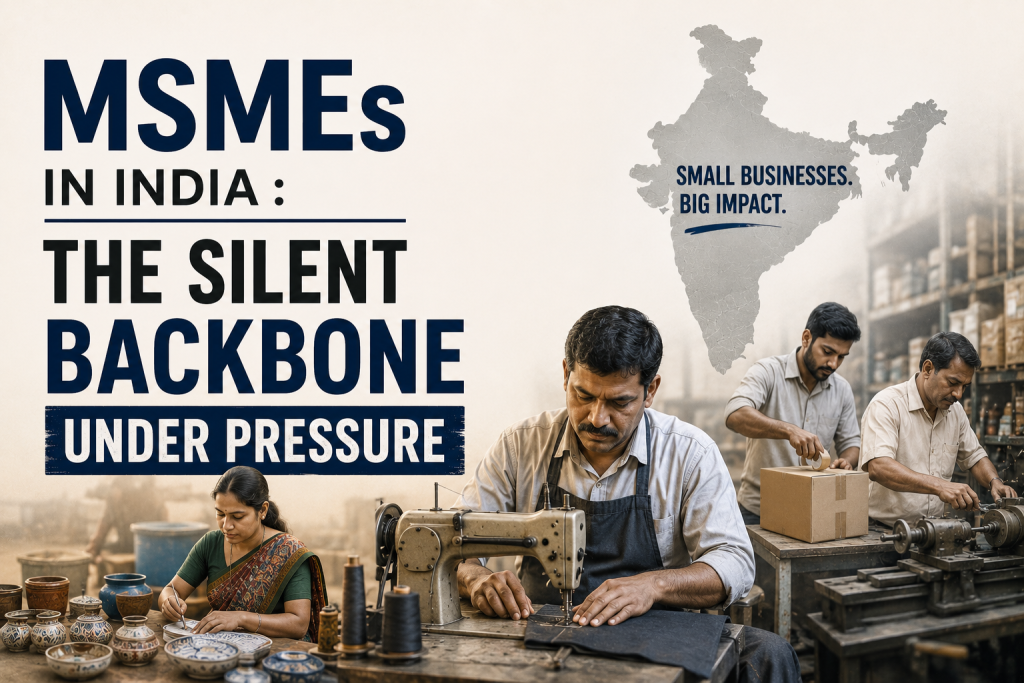
MSMEs contribute nearly 30 percent of India’s GDP and generate employment for more than 110 million people. They are the largest source of employment after agriculture and are central to local economic circulation. However, while large corporations often receive visibility, incentives, and structured policy support, millions of small enterprises continue operating under uncertainty, weak protection, and rising vulnerability.
One of the most pressing challenges today is livelihood insecurity caused by urban eviction and demolition drives. Across many Indian cities, anti-encroachment campaigns are removing street vendors, kiosks, and informal markets in the name of beautification, smart city expansion, and infrastructure development. Unfortunately, these drives frequently ignore the reality that informal enterprises are not temporary inconveniences; they are economic lifelines for millions of families.
The Street Vendors (Protection of Livelihood and Regulation of Street Vending) Act, 2014, was enacted to protect vendors through registration, vending zones, and rehabilitation mechanisms. Yet implementation remains weak in most cities. Many vendors continue operating without formal identity cards, designated spaces, or legal protection. Sudden demolitions destroy not only their structures but also customer relationships built over decades. The psychological impact of losing livelihood overnight is severe and often invisible.
The struggles of MSMEs did not begin today. Several economic shocks over the last decade have weakened small businesses significantly. Demonetisation in 2016 severely disrupted cash-dependent enterprises. Small traders, transport workers, food vendors, and local manufacturers experienced immediate liquidity shortages. Many enterprises lost customers, reduced production, or shut down permanently. While larger firms adapted through formal banking and digital systems, small entrepreneurs struggled to survive.
Soon after came the implementation of the Goods and Services Tax (GST). While GST aimed to create a unified national market, its compliance burden became extremely difficult for many micro-enterprises. Filing multiple returns, managing digital records, understanding tax categories, and dealing with penalties required technical capacities that many small entrepreneurs simply did not possess. For businesses operating on narrow margins, compliance costs became another financial burden rather than a supportive reform.
Access to affordable finance continues to remain a major structural challenge. Despite several government schemes, formal credit remains inaccessible for a large number of grassroots entrepreneurs. Banks often demand collateral, credit histories, formal documentation, and financial records that informal businesses cannot provide. As a result, many depend on private lenders charging extremely high interest rates. Loan repayment pressure, combined with unstable income, creates chronic financial stress.
Another emerging concern is the rapid transformation of markets due to digitalisation and technology. E-commerce platforms, automation, artificial intelligence, digital payments, cloud-based services, and online retail systems are reshaping economic ecosystems at an unprecedented pace. While technological advancement is necessary, the transition is uneven and exclusionary.
Millions of MSMEs still function in traditional ecosystems with limited digital literacy, poor internet access, outdated machinery, and inadequate technical support. Small retailers now compete with large online platforms offering deep discounts and integrated logistics systems. Local repair workers, artisans, and traditional manufacturers are struggling to maintain relevance in increasingly digitised markets. The issue is not resistance to change but unequal access to resources that enable adaptation.
Climate change is further intensifying the crisis. Heatwaves, floods, irregular monsoons, water scarcity, and rising energy costs are affecting production systems, transportation, agriculture-linked enterprises, and supply chains. Informal businesses operating in open markets and temporary structures are especially vulnerable to extreme weather conditions. Yet climate resilience support for MSMEs remains extremely limited in policy discussions.
The mental health dimension of entrepreneurial distress is another area receiving inadequate attention. MSME owners often carry the responsibility of entire families, employees, loans, rent, and business survival simultaneously. Unlike salaried workers, they lack income security, insurance protection, and social safety nets. Economic failure frequently translates into emotional isolation, anxiety, and depression. Unfortunately, entrepreneurship is celebrated publicly while the psychological burden of survival entrepreneurship remains ignored.
India must therefore rethink its approach toward MSME development. The solution cannot be limited to announcing credit schemes or startup slogans. What India requires is a comprehensive ecosystem approach that recognizes grassroots enterprises as essential national assets.
First, urban planning must become livelihood-sensitive. Cities should designate and legally protect vending and micro-enterprise zones integrated within economic planning frameworks. Development cannot become synonymous with displacement.
Second, compliance systems for small businesses must be simplified drastically. Tax systems, registrations, and digital reporting mechanisms should be proportionate to the scale of enterprises. A roadside tea seller or repair kiosk cannot be expected to function with the same compliance structure as a corporate entity.
Third, India needs large-scale investment in digital inclusion and technology adaptation for MSMEs. Affordable digital tools, AI literacy, e-commerce integration, bookkeeping systems, and business modernization support should reach even the smallest enterprises.
Fourth, social protection for informal entrepreneurs is urgently needed. Health insurance, pension systems, emergency credit support, and livelihood security mechanisms must become integral components of MSME policy.
Fifth, climate resilience planning must include small enterprises. Sustainable energy access, decentralized production systems, green entrepreneurship opportunities, and disaster preparedness support can strengthen long-term business sustainability.
Finally, policymakers must begin viewing MSMEs not merely as economic units but as human ecosystems. Every small enterprise supports families, local employment, skill systems, and community stability. When MSMEs collapse, the consequences extend beyond economics — they contribute to unemployment, migration, inequality, social unrest, and declining community resilience.
India’s future cannot be built only through large corporations, smart infrastructure, and global capital investments. The nation’s economic strength also depends on the resilience of millions of ordinary entrepreneurs working silently in markets, railway stations, villages, slums, workshops, and streets across the country.
The story of Pramath Mondal should compel India to pause and reflect. Economic growth without livelihood security is incomplete. Development without dignity is unsustainable. Protecting MSMEs is therefore not merely an economic agenda — it is a moral, social, and national responsibility.