
By Prof Ujjwal K Chowdhury
The latest NEET-UG 2026 controversy is not an isolated accident. It is the most recent public explosion of a deeper disease: India has built one of the world’s largest high-stakes examination machines without matching it with a world-class security, staffing, accountability and prosecution architecture. The body in question is the National Testing Agency, and the public anger is understandable because the institution now symbolises broken trust.
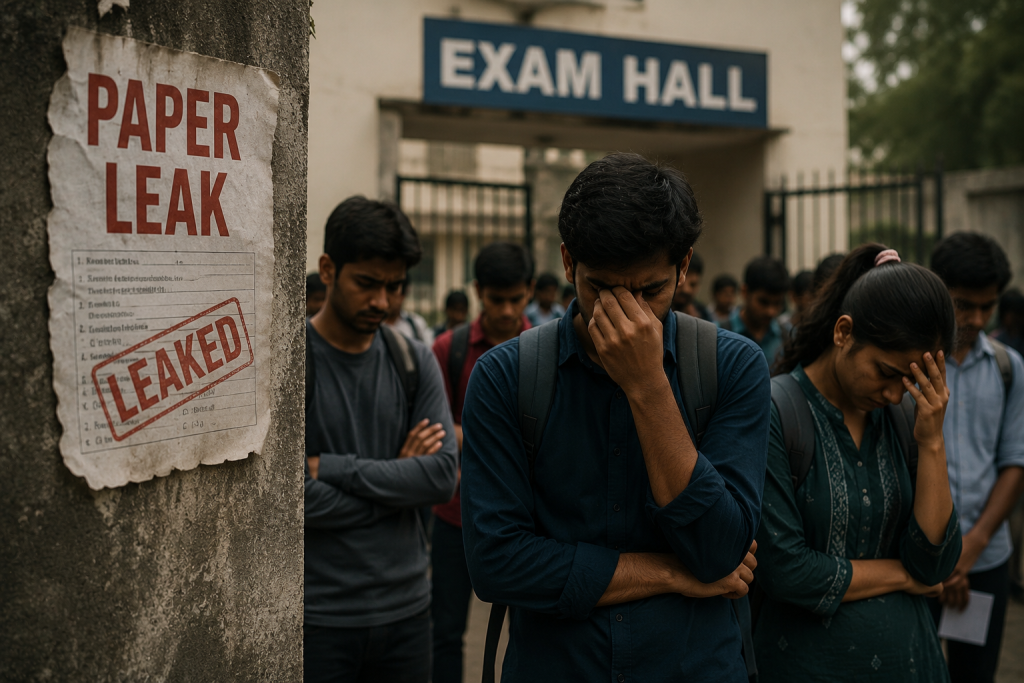
On 12 May 2026, the NTA officially cancelled NEET-UG 2026 held on 3 May, said the exam would be reconducted, referred the matter to the CBI, and admitted that the present examination process “could not be allowed to stand.” It also said no fresh registration or additional fee would be required and that fees already paid would be refunded. The Indian Express reported that the cancellation affected over 22 lakh candidates, with around 22.7 lakh registered and 22.05 lakh appearing; investigators reportedly found a “guess paper” of 410 questions, of which 120 appeared in the exam. The CBI has since registered an FIR and arrested five accused across cities, with charges including criminal conspiracy, cheating, breach of trust, corruption provisions and the Public Examinations Act.
The Exam Was Cancelled; Trust Was Already Broken
The tragedy is not only that a paper was allegedly leaked. The larger tragedy is that lakhs of serious students immediately believed it could have leaked. That is what institutional decay looks like: even before the investigation ends, the credibility of the system has collapsed in public imagination.
NEET is not an ordinary exam. It decides who becomes a doctor. It decides whether a student from a small town, a government school, a farming family, a lower-middle-class household, or a first-generation learner can enter the medical profession. For such an exam, even a small breach is not small. One leaked PDF, one compromised centre, one corrupt principal, one couriered paper, one Telegram group, one “solver” network—each is enough to poison the whole process.
Since 2014: From Scattered Leaks to a Parallel Exam Mafia
Paper leaks existed before 2014. Vyapam itself predates 2014. But the last decade has seen the problem become wider, faster, more commercial, more digitally distributed and more politically damaging. Newslaundry’s 2024 analysis documented 89 suspected paper leak cases over a decade, where either a case was lodged or the exam was cancelled, affecting at least 6.5 crore candidates. India Today reported another count: over 70 paper leaks in seven years across 15 states, disrupting 1.7 crore applicants.
These figures vary because definitions vary. Some count only cancelled exams. Some count FIRs. Some include school boards, recruitment tests and entrance exams. But the direction is unmistakable: India has moved from episodic cheating to an organised paper-leak economy.
The Business Model: Desperation In, Crores Out
A paper leak is not just “cheating.” It is a market. It has demand, supply, pricing, logistics, distribution, local franchisees and political protection.
The demand comes from India’s brutal scarcity economy: a few lakh seats, a few thousand jobs, and crores of aspirants. Families mortgage land, sell jewellery, take loans, shift children to coaching hubs, and invest years in exams. When a medical seat or government job is seen as the family’s escape route, a leaked paper becomes a black-market asset.
The supply chain is equally clear. Past investigations show recurring nodes: printing press insiders, school principals, centre superintendents, coaching operators, transport handlers, data vendors, local brokers, “solver” gangs, impersonators, corrupt officials, and digital distributors. India Today reported that leaks often involve money changing hands and the role of officials, teachers and printing press personnel, with social media enabling rapid paid circulation.
The 2024 NEET case showed how small physical breaches can become national scandals. The Supreme Court recorded that the 2024 leak at Hazaribagh and Patna was not disputed, and that the CBI’s material then indicated about 155 beneficiary students from those centres. The CBI later charge-sheeted six accused including the principal and vice-principal of Oasis School, Hazaribagh, alleging that they conspired with others to steal the NEET-UG 2024 paper; by September 2024, 48 persons had been arrested.
NTA: Too Big, Too Thin, Too Dependent
The NTA has become a giant gatekeeper. A parliamentary reply said that since its inception in 2018, NTA had conducted over 250 examinations involving over 5.5 crore candidates. Yet the same ecosystem has repeatedly shown signs of fragility. Hindustan Times reported that in its first five years, NTA faced operational problems, including technical glitches, language errors, dropped questions, normalisation disputes, and centre-allocation issues; a parliamentary panel found that at least five of the 14 competitive examinations conducted by NTA in 2024 and early 2025 faced major issues.
The Radhakrishnan High-Level Committee was created after the 2024 crisis to recommend reforms in the exam process, data security protocols and NTA’s structure. Its report itself recommended restructuring the NTA and strengthening institutional linkages. After the 2024 leak, the government reportedly created 16 new posts in NTA, three Joint Directors had joined by 2026, district-level coordination committees were created, and 94% of centres were shifted to government or government-owned buildings. These are useful steps. But the 2026 cancellation proves that incremental patchwork is not enough.
Punishment Is Slow; Deterrence Is Weak
The strongest incentive for the paper-leak mafia is not only money. It is the low probability of a fast conviction. Arrests make headlines. Trials drag. Kingpins get bail. Middlemen disappear. Beneficiaries often escape. Institutions move on. Students alone pay the immediate price.
The status of major cases shows the problem:
NEET-UG 2026: FIR registered, arrests made, investigation ongoing. No conviction yet; too early.
NEET-UG 2024: The Supreme Court refused a nationwide retest because it did not find material showing a systemic leak across the entire exam, though it acknowledged the Hazaribagh-Patna leak. CBI filed charge-sheets and said trial was on; an officer quoted by Hindustan Times said the 2024 probe was over in 2024-25, cases were charge-sheeted, and trial was continuing. But one alleged key figure, Sanjeev Mukhiya, was reportedly granted default bail after the CBI failed to file a charge-sheet against him within the mandatory period.
UGC-NET 2024: The exam was cancelled after alleged darknet/Telegram leak inputs, but the CBI later filed a closure report saying it found no evidence of a paper leak and that the circulated screenshot was allegedly doctored. That means an entire national exam was cancelled, but the criminal case did not establish the feared leak.
SSC CGL 2017/Tier-II 2018: CBI registered a case in May 2018 against 17 accused and others, including people linked to a private technology company, alleging conspiracy and cheating in the online exam. In 2019, the CBI charge-sheeted the alleged mastermind and two others; more than 30 lakh candidates had applied for over 8,000 vacancies. Court records also show allegations of remote access, leaked questions and answer keys posted on social media. Publicly visible material shows prosecution movement, but not a quick final deterrent conviction.
CBSE 2018: Delhi High Court records noted that Class XII Economics and Class X Maths papers were leaked from Una, Himachal Pradesh and circulated on WhatsApp; the Class XII Economics printed paper was also allegedly leaked one hour before the exam from a Delhi school. Again, the public memory is of leak, panic, re-exam and anger—not of swift exemplary punishment.
Vyapam: This remains the mother case. It involved impersonation, manipulated seating, forged answer sheets, officials, middlemen and political heat. Convictions are still arriving more than a decade later. In December 2025, a CBI court sentenced 12 accused to five years’ rigorous imprisonment in an MP PMT-2011 case. Another CBI court sentenced 10 accused to five years in a Patwari recruitment case linked to Vyapam. But acquittals also happen: in May 2025, a CBI court acquitted a constable accused in a Vyapam-linked proxy case because the prosecution failed to prove the allegations and forensic evidence was not conclusive.
REET 2021: Rajasthan High Court denied bail to an accused in a money-laundering case, noting allegations of payment of ₹1.20 crore and proceeds of crime of ₹1.06 crore. In 2025, the High Court declined to transfer the REET-2021 investigation to the CBI. The public record still points to prolonged litigation rather than final closure.
UP Police Constable and RO/ARO 2024: ED filed a supplementary prosecution complaint in January 2026 against 18 accused, alleging a systematic racket where leaked papers were sold to candidates and proceeds from one leak financed another; assets worth ₹1.02 crore were attached and the case is under trial.
This is the pattern: cancellation is instant, student suffering is instant, but justice is delayed, fragmented and often inconclusive.
Poor Governance of Professional Examinations
A professional exam has three promises: fairness, secrecy and finality. India is failing on all three.
Fairness fails when the rich can buy leaks. Secrecy fails when papers move through private vendors, weak storage, compromised centres, WhatsApp networks and human discretion. Finality fails when students must prepare again, litigate, protest, wait, and live under uncertainty.
This is especially cruel because the honest student carries all costs: coaching fees, travel, hostel rent, emotional trauma, lost months, family debt, social shame, and repeated psychological shock. The mafia risks arrest. The student risks their life trajectory.
What India Must Do Now
India does not need another committee alone. It needs an exam-integrity state.
First, create an independent National Examination Integrity Authority with statutory powers, audit teams, cyber forensics, surprise inspection powers and public annual reporting. NTA cannot be both operator and self-certifier.
Second, stop outsourcing core secrecy. Vendors may provide infrastructure, but question-setting, encryption, paper movement, centre allocation, invigilation command and forensic audit must remain under a secure public chain of command.
Third, use zero-trust exam logistics: encrypted item banks, multiple equivalent paper forms, last-mile digital decryption, GPS-tracked movement, sealed audit trails, CCTV-recorded strong rooms, biometric access logs, and automatic alerts for seal breach or unusual access.
Fourth, reduce single-point failure. NEET-style one-day, one-paper, all-India exams are security nightmares. Large exams should use multiple equivalent forms, multiple sessions, statistically validated equating, and carefully audited question banks. OECD notes that digital assessment can transform central assessments, but also requires countries to manage the challenges of technology-based administration.
Fifth, bring in serious post-exam forensics. ETS, for example, says it reviews score statistics after test sessions and monitors score trends by test centre, country and region to detect invalid scores. India should run mandatory anomaly detection: sudden centre-level score spikes, identical wrong answers, abnormal rank clusters, solver-pattern detection, and social-media leak matching.
Sixth, ban paper reuse and weak item recycling. The global SAT experience shows that content theft and reuse can become a major vulnerability; Reuters reported that SAT content theft had been identified in countries including South Korea, Egypt, Saudi Arabia and China, with answer keys available in some places. India must assume every exposed question is dead forever.
Seventh, create fast-track exam-offence courts. The Public Examinations Act provides tough penalties, including three to five years for unfair means and five to ten years plus a minimum ₹1 crore fine for organised cheating. But a law without fast conviction is a poster, not a deterrent.
Eighth, protect whistleblowers and reward early reporting. The 2026 case reportedly moved after early alerts. Whistleblowers, ethical teachers, honest officials and digital tipsters should receive legal immunity, anonymity and financial rewards.
Ninth, punish institutions, not only individuals. If a centre superintendent, school, coaching chain, vendor or printer is involved, penalties must include debarment, property attachment, recovery of full reconduct cost, and public blacklisting.
Tenth, stop treating students as collateral damage. When an exam is cancelled, there must be compensation: travel support for poor candidates, mental health helplines, free reattempt logistics, transparent timelines, and priority grievance windows.
The Final Question: Who Pays for the Lost Year?
Every leak is a theft. It steals not only a paper, but months of labour, family savings, sleep, dignity and faith in the republic. India’s paper-leak crisis is now a governance crisis. It is a corruption crisis. It is a youth justice crisis.
The exam mafia survives because the reward is immediate and the punishment is uncertain. That equation must be reversed.
Until then, every new exam notice will carry an invisible warning: prepare hard, but pray harder that the system does not betray you.
The author is a known academic and a pro-democracy advocate.
