
The nature of education is gradually shifting from rote-based instruction to learning that is meaningful, practical, and rooted in real-life experiences. Today, it is no longer enough for students to memorise concepts; they need to understand, visualise, and apply them. This shift in the education pattern is especially important for subjects like Mathematics and Science, which are often perceived as difficult and abstract when taught only through textbooks. Experiential learning helps bridge this gap by making learning engaging, relatable, and easier to comprehend. Reflecting on this changing approach, Pramodini Naik, Assistant Director, CYDA, highlighted that empowering teachers through exposure and hands-on learning is essential for improving classroom practices. She articulated that when teachers experience concepts through interactive and visual methods, they are better equipped to simplify complex ideas and inspire curiosity among students.
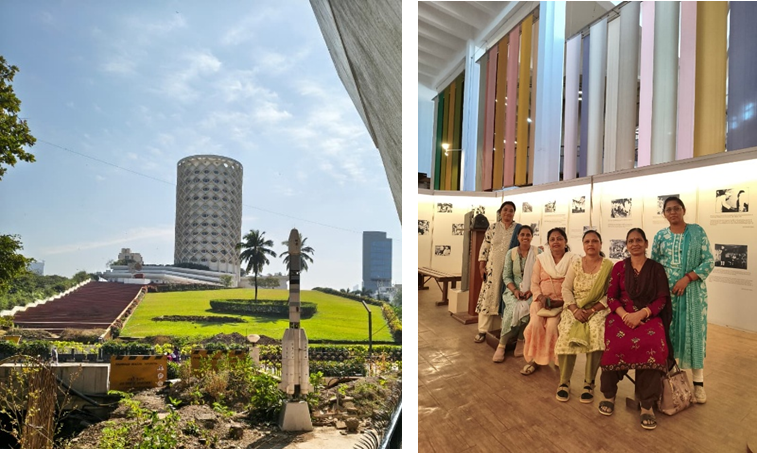
Experiential learning plays a crucial role in making education meaningful, relevant, and engaging. To strengthen the teachers’ teaching in Mathematics and Science, CYDA organised an educational exposure visit to the Nehru Planetarium and the Discovery of India Museum for 29 teachers from the Pimpri Chinchwad Municipal Corporation and three STEM trainers. The visit provided an opportunity to explore astronomy and human civilization through interactive and visual learning, making complex concepts easier to understand and teach.
CYDA has been consistently working with schools to improve students’ academic performance, particularly in Science and Mathematics, which are often seen as difficult and hard subjects. Through remedial education, teacher capacity-building programs, STEM-based activities, regular assessments and parental engagement, STEM trainers support the schools in bridging the learning gaps and strengthening conceptual understanding. The organization strongly believes that empowered teachers are the key drivers of improved student performance.
The Planetarium made learning astronomy a pleasant and engaging experience, while the Museum offered insights into the historical evolution of human civilization. The visit helped teachers connect theoretical classroom concepts with real-world contexts, promote curiosity, and encourage innovative teaching methods aligned with NEP 2020’s competency-based approach. Likewise, Sustainable Development Goal (SDG) 4 emphasizes inclusive and equitable quality education and lifelong learning opportunities. Another important objective was to motivate teachers to integrate experiential learning into their regular classroom practices.
At the Nehru Planetarium, teachers explored models, visuals, and simulations such as the solar system model, celestial spheres, constellations, galaxy formations, phases of the Moon, eclipses, satellite movements, and space missions through dome shows and digital simulations. At the Discovery of India Museum, exhibits on the evolution of human civilization, Indus Valley Civilization, ancient tools, scientific advancements in ancient India, timelines of historical development, and cultural heritage helped teachers connect history with scientific progress.
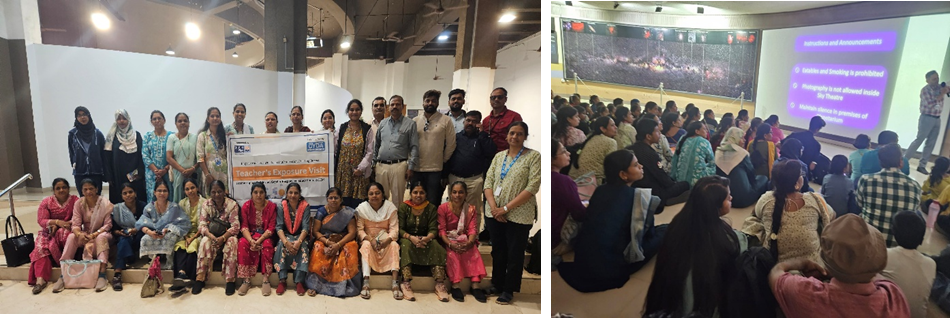
Teachers reported improved clarity in concepts related to astronomy (such as planets, stars, constellations, eclipses, and the solar system), space science (satellites, space missions, gravity, and planetary motion), and historical development (early human settlements, technological evolution, and scientific contributions of ancient civilizations). Teachers expressed that visual experiences from the planetarium and museum would help them develop storytelling-based lessons, for example narrating the journey of planets around the Sun using charts, models, and student role-play, or explaining human evolution through timelines and picture cards.
Teachers also planned to implement activity-based learning by encouraging students to create solar system models, draw constellation maps, conduct simple gravity-related experiments, and engage in group discussions and projects related to historical periods. These methods are expected to improve student engagement, critical thinking, curiosity, and conceptual understanding.
In the long term, such exposure visits foster scientific temper, creativity, and experiential learning among teachers and students alike. Through sustained efforts in teacher capacity building and STEM education, CYDA remains committed to creating impactful learning experiences that support students’ academic growth and holistic development.
