
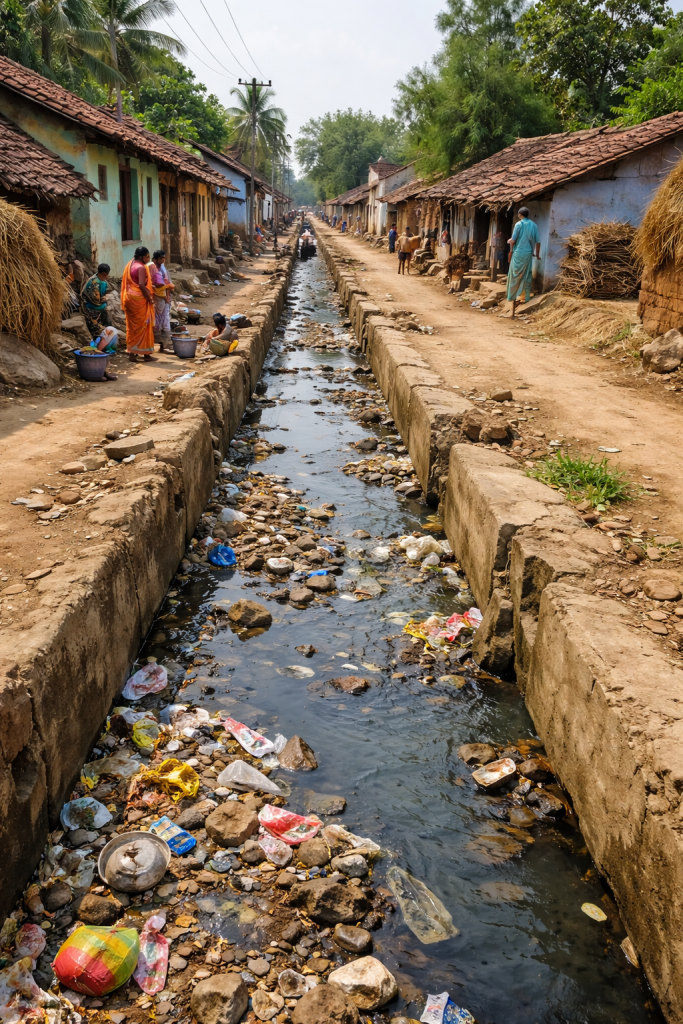
The drainage system reflects the level of planning and foresight in development. An effective system plays a crucial role not only in maintaining public health but also in enhancing the overall cleanliness and appearance of a settlement. Despite its importance, large gaps in drainage infrastructure persist in rural India. In this article, Dr Nageswara Rao, Joint Director, CYDA, emphasises the importance of efficient drainage systems, particularly in rural contexts. He highlights existing gaps in sanitation and wastewater management while also drawing attention to traditional drainage practices, where systems were designed to be sustainable and locally appropriate. By connecting past knowledge with present challenges, the article explores practical, low-cost solutions and offers insights to improve long-term sustainability and public health outcomes.
Drainage problems in rural India stem from the absence of planned sewage systems, resulting in widespread accumulation of greywater, open drains, and poor sanitation. Around 47% of rural Indian households lack drainage, leading to waterlogging, serious health hazards, and contamination of local water sources. These issues are intensified by improper waste disposal, clogged channels, and inadequate maintenance.
International reports by UN‑Water and UNEP note that while access to piped water in rural India has expanded, large gaps in safe drainage and wastewater treatment remain. A 2024 study finds that about 40% of rural households with piped water still rely on open drains, heightening the risk of disease. Open drainage is prevalent in more than half of India’s districts, with household‑level open‑drain prevalence exceeding 42%.
Open drains are far more common in rural communities, whereas closed drains predominate in urban areas. Households from the lowest socioeconomic groups are most likely to rely on no drainage or open drains. In contrast, those in the highest socioeconomic groups are most likely to have closed drains. Only about one‑third of Indians have access to closed drains, which reduces direct exposure to hazardous flows. However, treatment of the sewage carried through these closed systems remains uncertain. Government data indicate that less than 28% of India’s sewage is currently treated, implying that much of it is discharged untreated into rivers, ponds, and other water bodies, exposing communities to waterborne diseases.
Ancient Indian history of drainage and wastewater management:
Ancient India made a landmark advance in sanitation during the Indus Valley Civilisation (3300–1300 BC) with the introduction of organised sewage systems. The ruins of Harappa, Mohenjo‑daro, and Dholavira reveal sophisticated drainage networks that reflect a strong commitment to cleanliness and public health, and later served as models for urban planning in other civilisations.
These systems were adapted to local cultural and economic conditions. Cities were laid out with complex networks of brick‑ and stone‑lined channels that carried wastewater through the streets. Terra‑cotta pipes collected household effluent and directed it into street drains, often using sedimentation traps. Cesspits at junctions helped prevent clogging and allowed periodic cleaning. Wastewater was often reused: kitchen scraps were composted, and people carefully separated dirty bathing water from drinking water sources, reflecting a high level of hygiene awareness. Over time, however, much of this knowledge about advanced drainage and wastewater management was lost and forgotten.
Why drainage system management is critical in rural India:
Drainage system management is critical in rural India because inadequate or absent drainage directly leads to waterlogging, stagnant wastewater and the spread of waterborne diseases such as diarrhoea, typhoid, and vector‑borne illnesses. With a large share of rural households relying on open drains or no drainage at all, untreated greywater and sewage frequently flow into fields, ponds, and local water bodies, contaminating drinking‑water sources and undermining soil and crop health. Well‑designed drainage systems not only safeguard agricultural productivity by preventing waterlogging, improving soil aeration, and reducing erosion, but also enable safer wastewater disposal that aligns with the broader goals of sanitation and hygiene under flagship programmes such as Swachh Bharat and Jal Jeevan Mission. In essence, robust rural drainage is not merely a technical requirement but a fundamental pillar of public health, environmental protection, and sustainable rural livelihoods.
Drainage System Management in Rural Andhra Pradesh- Key Challenges:
Rural Andhra Pradesh faces major challenges in household‑level drainage, driven mainly by inadequate infrastructure, limited financial resources, and weak solid‑waste management that clogs existing systems. Persistent problems include widespread open and unhygienic drains in low‑income households, severe groundwater contamination, and an urgent need for low‑cost, decentralized treatment solutions such as soak pits and Magic Drains.
- Inadequate Infrastructure & Open Drains: Most rural households lack proper underground or covered sewerage networks and instead depend on open, kutcha drains. These crude channels allow wastewater to stagnate, creating breeding grounds for mosquitoes and posing serious health risks.
- Solid‑Waste Clogging: Poor household‑level waste management causes solid waste to mix with liquid sewage, blocking drains, blocking flow, and leading to frequent overflows in residential areas—especially during heavy rainfall.
- Socio‑economic Disparities: Households in the lowest wealth quintile, particularly those from marginalised castes/ communities, are much more likely to have either open drainage or no drainage at all. This directly links poor sanitation and exposure to disease to poverty and social exclusion.
- Technical and Financial Constraints: Rural areas often lack both the technical expertise and the financial resources to design, install, and maintain modern sewage systems. As a result, rural communities continue to rely on rudimentary, often poorly functioning drainage arrangements.
- Groundwater Contamination & Waterlogging: Ineffective drainage allows wastewater to accumulate and seep into the soil, contaminating local groundwater used for drinking and domestic purposes. At the same time, during the rainy season, inadequate systems trigger waterlogging, damaging property and farmland.
- Low Awareness & Poor Maintenance: Public awareness of proper sanitation and drainage practices remains limited, and even simple, low‑cost systems are rarely maintained. This undermines the long‑term effectiveness of any interventions and perpetuates unsanitary living conditions.
Magic Drains – A sustainable solution experimented in Rural Andhra Pradesh.
The Magic Drain pilot project is a pioneering rural sanitation initiative launched in Andhra Pradesh under the Mahatma Gandhi National Rural Employment Generation Scheme (MGNREGS), implemented by the Swachha Andhra Corporation (SAC). Designed to replace expensive, rigid concrete drainage systems, these nature‑based soakage channels effectively manage household greywater while recharging local groundwater tables.
Magic Drains filter greywater through strategically engineered layers of gravel, medium‑sized aggregates, and large boulders. This layered filtration eliminates foul odours, prevents the breeding of vector‑borne mosquitoes, and acts as a stormwater buffer, reducing street flooding during heavy monsoon rains. Implemented at roughly 13% of the cost of standard cement drains, this pilot—spearheaded by the Andhra Pradesh Panchayat Raj & Rural Development Department is currently active in districts such as NTR, Eluru, Visakhapatnam, Nandigama, Vizainagaram and Kakinada, paving the way for state‑wide sustainable sanitation by 2026.
Conventional cement drains cost approximately ₹5 lakh per 100 meters, making them financially unfeasible for many rural stretches. In comparison, Magic Drains is a low‑technology, high‑impact solution.
Key features of the Magic Drain system
- Cost‑effective design: Magic Drains cost only around 13% of traditional concrete (CC) drains—approximately ₹1,000 per meter, compared to ₹4,000–₹5,000 for standard cement drains.
- How it works: The system functions as a large, wall‑free pit filled with graded stone layers: large rocks at the bottom and progressively smaller aggregates on top. This arrangement acts as a natural filter for wastewater, allowing it to percolate safely into the soil.
- Environmental benefit: By encouraging controlled percolation, the system prevents untreated sewage and greywater from flowing into open fields, drains, or local water bodies, thereby protecting surface ecosystems.
- Groundwater recharge: As filtered water seeps into the ground, it helps raise the groundwater table, contributing to improved water security in rural areas.
- Maintenance: The top layer of the stone filter must be cleaned of accumulated silt and debris at regular intervals to maintain its permeability and ensure continued absorption of water.
- Implementation: The system is implemented under the MGNREGS framework to enhance rural sanitation and livelihoods. Pilot projects have already been rolled out in districts such as Visakhapatnam, NTR, and Eluru.
- Sustainable alternative to open drains: Magic Drains offer a sustainable alternative to open, unhygienic drains, effectively managing greywater while creating a cleaner, healthier, and more resilient rural environment.
The Swachha Andhra Corporation (SAC), in collaboration with the Andhra Pradesh Panchayat Raj & Rural Development Department, is planning a phased expansion of the Magic Drain system across the state. Building on successful pilots in districts such as NTR, Visakhapatnam, Kakinada, Nandigama, and Vizianagaram, SAC aims to scale up the technology to additional gram panchayats and villages, particularly in areas with poor sanitation and low groundwater levels. Government directives have mandated that Magic Drains be rolled out in all districts in a staggered manner, with initial demonstration stretches in selected colonies and a focus on SC/ST habitations and water‑stressed blocks. This planned expansion positions Magic Drains as a core component of Andhra Pradesh’s long‑term rural sanitation and groundwater‑recharge strategy, aligned with MGNREGS and Swachh Bharat‑related initiatives.
References:
- The New Indian Express (29 Nov 2025). Magic Drains to solve wastewater woes in Andhra Pradesh.
- Jain A, Harrison C, Kumar A, Kim R, Subramanian S V (2024). Open drains drain health. India Water Portal
- UN World Water Development Report 2022.
