
On the occasion of the 195th birth anniversary of Savitribai Phule, ImpactLens correspondent Soumyashree Mohanty journeys through rural Maharashtra to examine how gender, power, and inequality continue to shape everyday lives. Moving beyond statistics and theory, her narrative captures voices from the ground-of women negotiating tradition and resistance-revealing how Phule’s legacy still echoes in contemporary struggles for dignity, education, and equality
It has been 178 years since Savitribai Phule opened India’s first school for girls in Pune and laid the foundation for women’s education in the country. Her struggle against caste and gender-based discrimination and her fight for equality continue to inspire generations. Yet, as we speak about progress and empowerment today, an important question remains. How far have women really come, especially at the grassroots level?
Government reports often highlight India’s achievements in women’s empowerment. These numbers suggest growth and advancement. However, empowerment cannot be measured by statistics alone. It must be understood through lived realities. To truly assess progress, we must listen to women’s everyday experiences and examine how power, control, and decision-making operate in their lives.
Listening to Women Beyond Statistics
As I moved through villages in rural Maharashtra, it was the voices, stories, and everyday struggles of women that gave meaning to the journey.
Every woman I met was working. Most work on their own farms to reduce labour costs. Many also work on other people’s farms. Almost all of them have loans, and the stress of repayment is clearly visible in their conversations. Financial pressure shapes their daily routines, workload, and silence. In these villages women’s labour is central to household survival, yet it remains undervalued and largely invisible. Their work sustains families, but their voices rarely shape decisions.
Caste, Control, and Unequal Mobility
During my interactions, caste based differences became sharply visible. Women from lower castes are allowed to work on other farms. Allowed, as if they are commodities and needed permission. In contrast, women from upper castes are not permitted to work outside their own land. This is not due to a lack of work or physical exhaustion but because of deep rooted social control and caste based expectations.
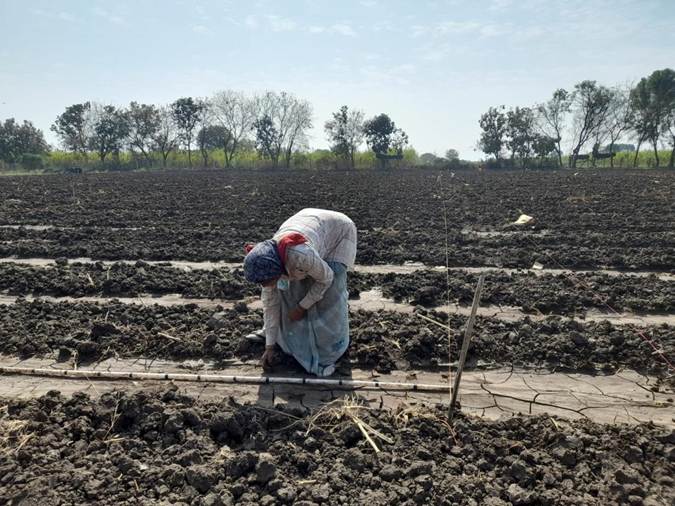
When I asked an upper-caste woman why she does not work on other farms, she said her husband does not allow it. She lives with her in-laws and they disapprove of her working elsewhere. Meanwhile, women from lower castes shared that they work wherever work is available. While mobility is not restricted for them, their workload is far heavier. They carry the double burden of caste and gender, working longer hours with fewer choices.
A Mother’s Dream Amidst Hardship
One interaction remains deeply etched in my mind. A woman from a lower caste spoke about her dream of sending her daughter to college and seeing her financially independent. She said, “I want to give my daughter a better life. I do not want her fate to be like mine. My parents married me off at a very early age. I was working on farms before marriage and I am still working.”
Her hands were covered in mud and her voice trembled as she spoke. Yet, despite the pain in her eyes, she smiled softly. That smile held hope for her daughter and acceptance of her own hardship. It reflected how women often imagine change not for their own lives but for the next generation.
Working Without Financial Freedom
Although women in these villages work for long hours, often more than ten hours a day, financial independence remains out of reach. They hand over their income to their husbands and accept this as normal practice. In society, it is a common belief that women are not capable of managing money. One upper-caste woman shared,“We have loans. Sometimes he gets irritated if people call him for repayment. I cannot ask him where he spends the money, but I must inform him about my expenses.” Her words revealed not only economic dependence, but also emotional restraint and fear.
Women’s participation in the labour force may be increasing, but participation alone is not empowerment. Without control over income and financial decisions, women’s work continues to benefit others more than themselves.
Patriarchy in Everyday Life
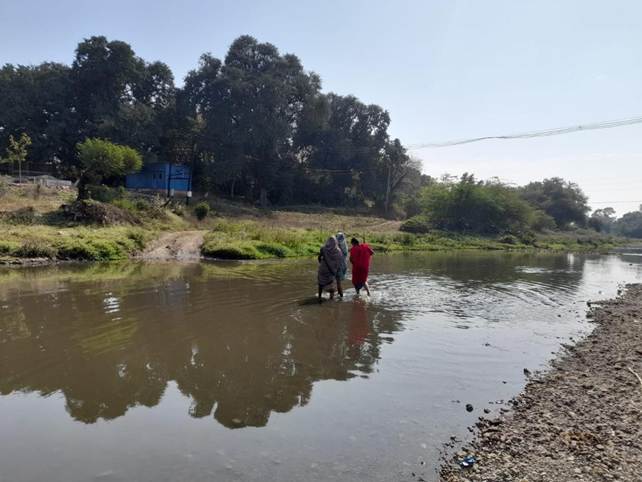
One afternoon, around one o’clock, we visited an agricultural field where women were working for ₹300 per day under extreme heat. To reach the field, we had to cross a small river with knee-deep water. Dirty village water flows into it, making it unhygienic and unsafe. The women cross this river every day. Health risks, such as skin infections, are real but secondary. For them, earning a livelihood and repaying loans matter more than personal safety.
When we returned to one woman’s home, her husband was sitting inside, neatly dressed. He said he was unemployed and waiting for another contract. When we asked the couple to sit together for a discussion, the woman sat on the floor while the man sat on a chair. He hesitated to sit on the floor with her and she hesitated to sit on the chair with him. This quiet moment spoke volumes about power, hierarchy, and inequality within the household. Patriarchy is visible in every village, deeply embedded in daily life. What is more striking is how women themselves have internalised these norms.
Need for Gender Dialogues
There is a clear need to organise gender sensitisation dialogues for couples in villages. Such processes can create critical and reflective spaces where couples will able to articulate perspectives that are usually silenced within domestic settings. Through participatory methods, these dialogues will examine socially constructed gender roles, normative stereotypes, and power relations within households. This approach emphasises the importance of sustained and context-specific gender discourse as a foundational element for advancing gender equity in rural communities.
However, transforming deeply rooted beliefs requires time and continuous engagement. During participatory group activities, participants are encouraged to reflect on everyday practices, behaviours, and assumptions within intimate relationships.
Gender discrimination does not always manifest in overt or extreme forms. It is often embedded in everyday language, humour, silences, and socially accepted behaviours. Addressing these subtle yet pervasive norms necessitates sustained dialogue and long-term engagement rather than isolated or one-time interventions.
Beyond Policies: The Unfinished Journey
These field experiences make one thing clear. Empowerment is not only about schemes, policies, or participation. It is about transforming power relations, questioning norms, and redistributing decision-making within families and communities.
Savitribai Phule’s struggle was not only about access to education. It was about dignity, equality, and justice. Until women at the grassroots can work without fear, earn without surrendering control, and speak without hesitation, the journey she began remains unfinished.
