
(Talking to Adolescents on Reproductive Health and Gender)
By: Rohit Salunkhe, CRC Coordinator
Supported by: Coforge
Adolescence is a critical stage of growth marked by rapid physical, emotional, and social changes. During this transition, young people often struggle with questions related to bodily changes, identity, relationships and decision-making. Still, research consistently highlights that many adolescents continue to lack reliable information, safe spaces and adolescent-friendly support systems to address these sensitive issues.
Recent evidence from Maharashtra highlights persistent gaps in adolescent health awareness and service uptake. Studies show that awareness of Adolescent-Friendly Health Clinics (AFHCs) remains extremely low—only 7–16% of adolescents know about these facilities, significantly limiting their ability to access reliable reproductive health information, counselling, and supportive services (VMMC & Safdarjung Hospital, 2024). Parallel reviews of the national Rashtriya Kishor Swasthya Karyakram (RKSK) reveal that even where services are available, adolescents often refrain from using them due to low confidence, stigma, and limited communication skills (Kumari et al., 2022).
Together, these findings show a consistent pattern: adolescents are underserved not only because of inadequate awareness but also due to social and psychological barriers that restrict help-seeking behaviour. This reinforces the urgent need for adolescent-friendly educational spaces—safe environments where young people can learn openly, express themselves without judgement, and seek timely support for their physical, emotional, and social well-being.
Why TARANG?
To bridge these gaps and empower young people with correct information, TARANG – Talking to Adolescents on Reproductive Health and Gender was designed as an interactive, safe and adolescent-friendly initiative. TARANG provides adolescents with a platform to learn about reproductive health, gender equality, emotional well-being and personal safety, topics that are often neglected or considered taboo in homes, schools and communities.
Challenges identified among adolescents
- Limited awareness about reproductive health and puberty
- Misconceptions and inaccurate information
- Poor understanding of mental health and emotional well-being
- Hesitation in speaking openly with peers, teachers or parents
- Low confidence in making informed decisions
- Difficulty in navigating gender-related expectations and stereotypes
- Limited access to adolescent-friendly guidance and support systems
TARANG Workshop
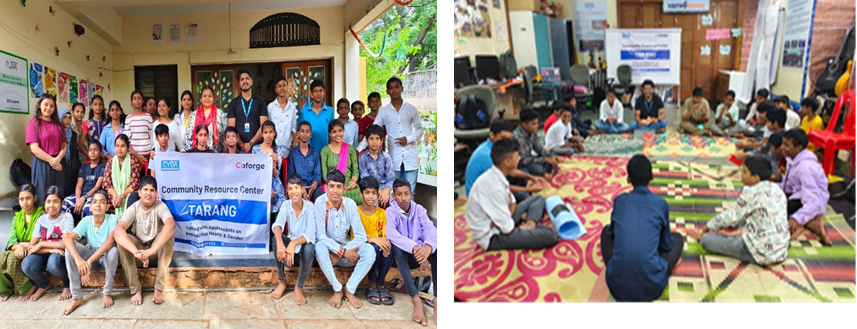
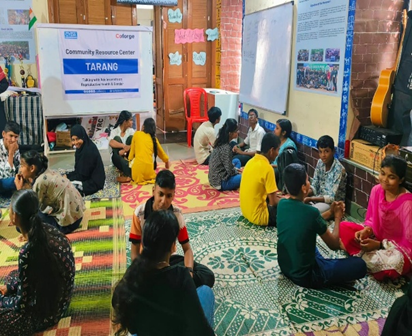
To address these issues, CRC Coordinator at the Centre for Youth Development and Activities (CYDA), conducted a two full day comprehensive TARANG workshop for 40 adolescents.
Core topics covered
1.Puberty & Reproductive Health
(Understanding bodily changes, structure, hormones)
2. Menstrual Hygiene Management
(Understand menstruation, hygiene, myths, and support. Separate sessions for girls and boys)
3. Personal Safety & Abuse Prevention
(Boundaries, good touch, bad touch saying “No”, online safety, recognising abuse)
4. Mental Well-being
(Emotional changes during puberty, stress management, body image, self-esteem)
5. Communication Skills & Confidence Building
(Assertiveness, expressing feelings, decision-making, negotiation skills)
6. Gender and Equality
(Respect, gender norms, stereotypes, equitable behaviour, consent basics)
7. Sexuality & Contraceptive Methods
(Basic sexuality concepts, attraction, consent, contraceptives — age-appropriate)
8. Sexually Transmitted Infections (STIs)
(Transmission, prevention, stigma reduction, accessing help)
9. Reporting Mechanisms & Support Systems
(How to report abuse, access helplines, clinics, counsellors; knowing rights)
Methodology
To ensure meaningful participation and comfort, facilitators used a combination of experiential and participatory learning techniques, including:
- Role-plays
- Group discussions
- Scenario-based learning
- Guided open conversations
This adolescent-friendly approach encouraged participants to ask questions freely, challenge misconceptions and learn from real-life examples. Facilitators maintained a safe, non-judgmental environment where every adolescent felt heard and respected. A baseline assessment was conducted before the workshop to identify existing knowledge levels, misconceptions, and the training needs of the group.
| Key Indicator | Baseline (%) | Endline (%) |
| Reproductive Health Knowledge | 18% | 82% |
| Gender Awareness & Equality | 20% | 80% |
| Mental Health & Emotional Understanding | 22% | 84% |
| Personal Safety & Abuse Prevention | 25% | 88% |
| Communication & Confidence Levels | 15% | 78% |
Impact of TARANG Training: 85% (34 adolescents)
The TARANG workshop led to visible and meaningful transformation among participants.
- Adolescents who were initially shy began participating confidently in discussions.
- Knowledge of reproductive health, menstrual hygiene, contraception, and gender equality improved significantly.
- Participants developed healthier emotional awareness, improved communication skills, and greater respect for personal boundaries.
- Many adolescents displayed enhanced empathy, teamwork, and leadership qualities.
- Several participants voluntarily emerged as peer supporters, promoting responsible behaviour, accurate information-sharing, and respectful relationships within their communities.
Current Status of Participants (a few months after Training) 85% (34 adolescents)
The long-term effects of TARANG have been encouraging:
- Adolescents communicate more confidently with peers, teachers, and parents.
- They openly discuss mental health, body changes, and reproductive topics with reduced stigma.
- Many have initiated awareness efforts within their CRC groups, sharing safety tips and promoting gender-respectful behaviour.
- School Teachers observed improvements in conflict resolution, digital safety practices, and responsible conduct.
- Participants show greater clarity in decision-making and self-awareness in daily life.
These results reflect the effectiveness of structured, interactive adolescent education in improving knowledge, attitudes, and behaviours. TARANG has demonstrated the power of structured, empathetic, and interactive learning spaces in strengthening adolescents’ understanding of reproductive health, gender, and emotional well-being. Supported by Coforge and implemented by CYDA, the programme has improved knowledge among adolescents and also built confidence, leadership, and peer support.
Reference:
VMMC & Safdarjung Hospital. (2024). Accessing Adolescent Friendly Health Clinics in India. Centre for Women’s Development Studies. https://vmml-cwds.ac.in/sites/default/files/202404/Accessing_Adolescent_Friendly_Health_Clinics_in_India.pdf
Kumari, S., Singh, V., Mehra, S., & Chauhan, A. (2022). Situational analysis of Rashtriya Kishor Swasthya Karyakram (RKSK) in selected states of India. Indian Journal of Community Medicine, 47(4), 593–598. https://journals.lww.com/ijcm/fulltext/2022/47040/situational_analysis_of_rashtriya_kishor_swasthya.16.aspx
