
Malnutrition can be effectively addressed when government systems, civil society, corporate social responsibility, and communities work together through a First 1000 Days approach. Drawing from a successful Shahada block intervention, Jayashree Sapkal & Anamika Dey highlight how community-centric, system-strengthening models can deliver sustainable maternal and child nutrition outcomes at scale.
Shahada block in Nandurbar district is a predominantly tribal, migration-prone region marked by chronic socio-economic vulnerabilities. Despite the presence of flagship government schemes such as ICDS, NHM, and POSHAN Abhiyaan, malnutrition among pregnant women, lactating mothers, and children under two years of age has remained persistently high.
Multiple structural and social barriers constrain outcomes: limited awareness of entitlements, weak last-mile follow-up, inadequate continuity of care, low institutional trust, and deeply entrenched norms such as early marriage, repeated pregnancies, suboptimal infant feeding practices, and large family sizes. Seasonal migration further disrupts service access and follow-up, compounding nutrition risks during the most critical life stages.
The intervention described here emerged from the recognition that malnutrition is not merely a food deficit, but a systemic failure shaped by health services, care practices, governance gaps, and behavioural norms. Addressing it required an integrated, people-centred strategy aligned with the First 1000 Days approach—from pregnancy to a child’s second birthday—while strengthening existing public systems rather than substituting them.
Program Philosophy and Conceptual Framework
Rather than creating parallel delivery mechanisms, the intervention focused on ecosystem strengthening—working through existing frontline systems, democratic institutions, and community structures. The approach was grounded in an integrated Demand–Supply–Governance–Behaviour Change framework, designed to complement government programs while improving their effectiveness at the village level. leaked porn thickbhabie69free
The model sought to:
- Strengthen community demand for maternal and child nutrition entitlements
- Improve the quality, responsiveness, and continuity of public health services
- Activate local governance institutions to own nutrition outcomes
- Enable sustained behaviour change through continuous follow-up and counselling
This multi-pronged design ensured that improvements were not episodic but embedded within everyday community and institutional functioning.
Strengthening Community Demand for Nutrition and Health Services
In the Shahada block, many eligible families were enrolled in schemes but remained passive recipients, often unaware of the importance of service continuity or their own role in maternal and child health outcomes. The intervention, therefore, focused on transforming beneficiaries into informed stakeholders.
Village-level Poshan Melavas were organised across all project villages during Poshan Maah 2025. These events went beyond information dissemination, using participatory discussions, demonstrations, and local examples to help women distinguish between healthy and unhealthy maternal and child practices. Topics included antenatal care, anaemia prevention, exclusive breastfeeding, complementary feeding, and nutrition during pregnancy and lactation.
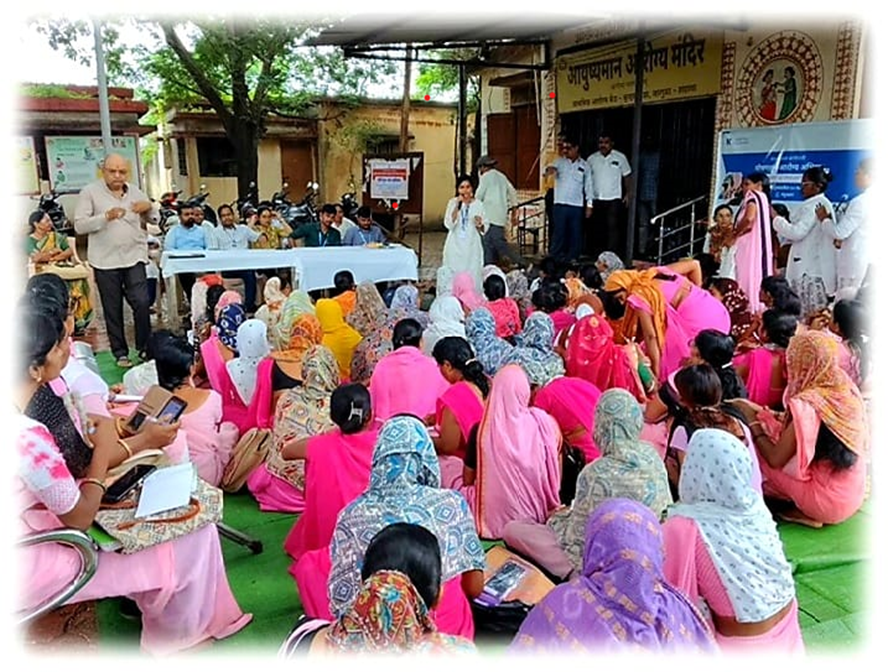
Recognising the strong link between family size and malnutrition, Family Planning Mahiti Corners were initiated. These addressed the contextual reality of families with seven to eight children, where maternal depletion and poor child care were common. Through respectful counselling and voluntary consent, 43 women were mobilised and supported for family planning registration at the rural hospital within a single month—an outcome rarely achieved through routine outreach alone.
Culturally rooted communication strategies were critical. Street play campaigns, performed in local dialects using music and storytelling, addressed sensitive themes such as early marriage, adolescent pregnancy, anaemia, and miscarriage prevention. These performances attracted large community gatherings and stimulated open discussions often avoided in formal meetings.
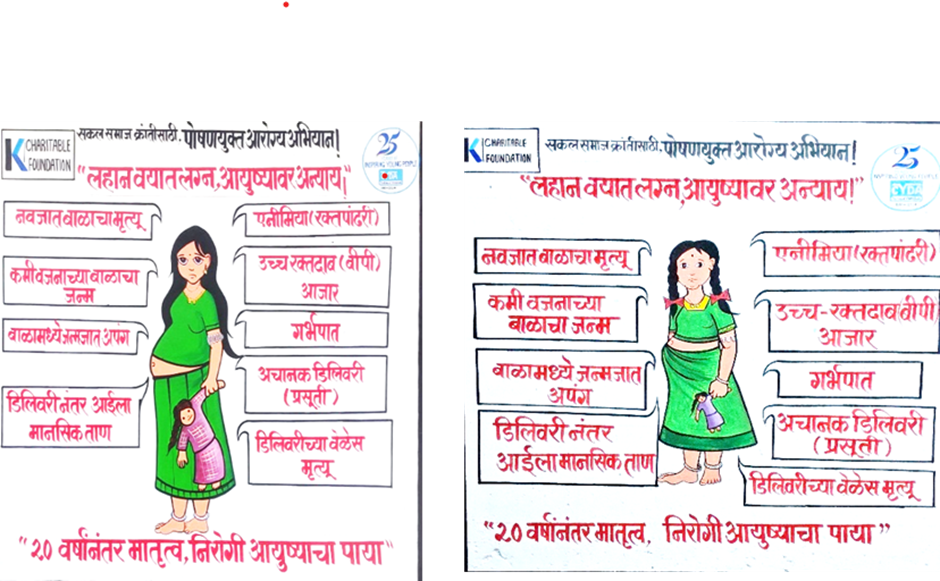
To reinforce messages beyond events, poster exhibitions and nutrition-themed wall paintings were created in prominent village locations. These visual reminders—covering breastfeeding, weaning, anaemia prevention, and the risks of early pregnancy—became part of the everyday landscape, sustaining awareness long after meetings ended.
Improving Supply, Quality, and Responsiveness of Public Services
The intervention was guided by the principle of system facilitation, not system substitution. Village-based health workers were introduced not to replace Anganwadi Workers or ASHAs, but to strengthen last-mile follow-up, data use, and coordination.
Village Health Workers (VHWs), selected from within the same communities, were equipped with infantometers and weighing machines. This enabled regular growth monitoring and early identification of Severe Acute Malnutrition (SAM) and Moderate Acute Malnutrition (MAM). Close coordination with Anganwadi centres, PHCs, and Nutrition Rehabilitation Centres (NRCs) improved referral pathways and reduced delays, dropouts, and missed follow-ups.

Capacity-building sessions were conducted for frontline workers—ASHA, Anganwadi Workers, and ANMs—at the PHC level. These sessions strengthened technical understanding of maternal and child nutrition, anaemia management, and counselling protocols, while reinforcing the frontline workforce’s central role in delivering quality services.
With support from the public health system, anaemia screening camps were organised across all villages. Adolescent girls and women underwent haemoglobin testing, accompanied by short orientation sessions on iron-rich diets, vitamin C absorption, and the long-term consequences of anaemia. These camps increased both detection and treatment adherence.
Activating Local Governance and Democratic Institutions
Malnutrition was positioned not only as a health issue, but as a matter of local governance and accountability. Gram Panchayats, Village Health Nutrition and Sanitation Committees (VHNSCs), and Gram Sabhas were actively engaged to build collective ownership of nutrition outcomes.
Panchayat members and VHNSC representatives supported the identification of vulnerable families, monitored service delivery, and facilitated referrals. An exposure visit to a Nutrition Rehabilitation Centre was organised for PRI and VHNSC members from all villages, strengthening their understanding of institutional care for severely malnourished children and reducing stigma around NRC referrals.
Continuous orientation of elected representatives—particularly young and proactive Sarpanchs—highlighted their role in addressing early marriage, maternal health, and child nutrition. As a result, nutrition and health issues were formally discussed during Independence Day Gram Sabha meetings, marking a significant shift toward people-centric governance of social issues.
Enabling Sustained Behaviour Change Through Rigorous Follow-Up
Behaviour change in nutrition is incremental and requires persistence. One-time awareness sessions rarely alter deeply embedded practices. The intervention, therefore, prioritised daily follow-up, repeated counselling, and social reinforcement.
Village Health Workers conducted door-to-door visits, ensuring continuous engagement with pregnant women, lactating mothers, and families with children under two. Currently, 390 children under two years of age are monitored regularly, with monthly data consolidation enabling early identification of risk and timely action.
To date, 802 mothers have received household-level counselling on exclusive breastfeeding, complementary feeding, maternal nutrition, and iron-folic and calcium supplementation. Structured lactation assessments showed measurable improvements, with 229 mothers demonstrating improved breastfeeding practices.
Family planning counselling was integrated into nutrition discussions, reinforcing the message that healthy spacing enables better maternal recovery, improved child care, and reduced malnutrition risk. By linking nutrition with reproductive health, the intervention addressed root causes rather than symptoms.
Outcomes, Learning, and Scale-Up Potential
The Shahada experience demonstrates that malnutrition reduction is achievable when communities are empowered, public systems are strengthened, and governance structures are activated. Key outcomes include improved service uptake, early identification of at-risk children, increased family planning adoption, stronger frontline capacity, and visible shifts in community norms.
Most importantly, the model is replicable and scalable. It does not rely on parallel infrastructure or high external inputs. Instead, it enhances the effectiveness of existing government programs by strengthening demand, accountability, coordination, and follow-up at the last mile.
For state and national governments, this First 1000 Days, community-centric approach offers a practical pathway to accelerate POSHAN outcomes in tribal and high-burden districts—demonstrating that sustainable nutrition gains emerge not from isolated interventions, but from integrated systems that place communities at the centre of change.
(This initiative is supported by K Corp)
