
By Prof Ujjwal K Chowdhury, Political Analyst & Senior Academic
A first person journey through memory grief, and hope in the Indian Sundarbans
Before the Delta I Learned to Listen
I grew up between two very different landscapes, and both taught me to listen. I studied in the Ramakrishna Mission at Aalo and later at Narendrapur until I attained adulthood. Those years gave me an education in discipline, simplicity and service. They also left me with a quiet unease about suffering that people learn to accept as normal. I did not have the language for it then. I only knew that a child who had less was not worth less.
At Jadavpur University, while pursuing my Master’s in International Relations, another education began. The campus opened the door to social realities and to the politics of socialism and social justice. Poverty was no longer a distant picture or a line in a textbook. It had history, power and policy behind it. I began to ask why some children inherit choices while others inherit only risks, why a village is praised for its resilience when it has first been denied safety, and why the poor are so often expected to adjust to conditions that the privileged would never accept.
That education did not make me an expert on other people’s lives. It made it more difficult for me to look away. The values I had absorbed at Aalo and Narendrapur met the questions I encountered at Jadavpur, and together they shaped a way of seeing. Service could not mean standing outside a community with answers. Social justice had to begin with listening to people who had been living with the problem long before the city discovered it.
1988 I Entered Through a Wedding
My first visit to the Sundarbans was in 1988, when I was studying for my Master’s in International Relations at Jadavpur University. I did not go in search of a landscape to describe, a report to write or a cause to claim. I went because Geetadi, the rural woman who had cared for me when I was a young man living alone, invited me to her daughter’s wedding in a village near Lakhsmikantapur. I went as someone who had been invited into a family, not as a benefactor or a guest of honour.
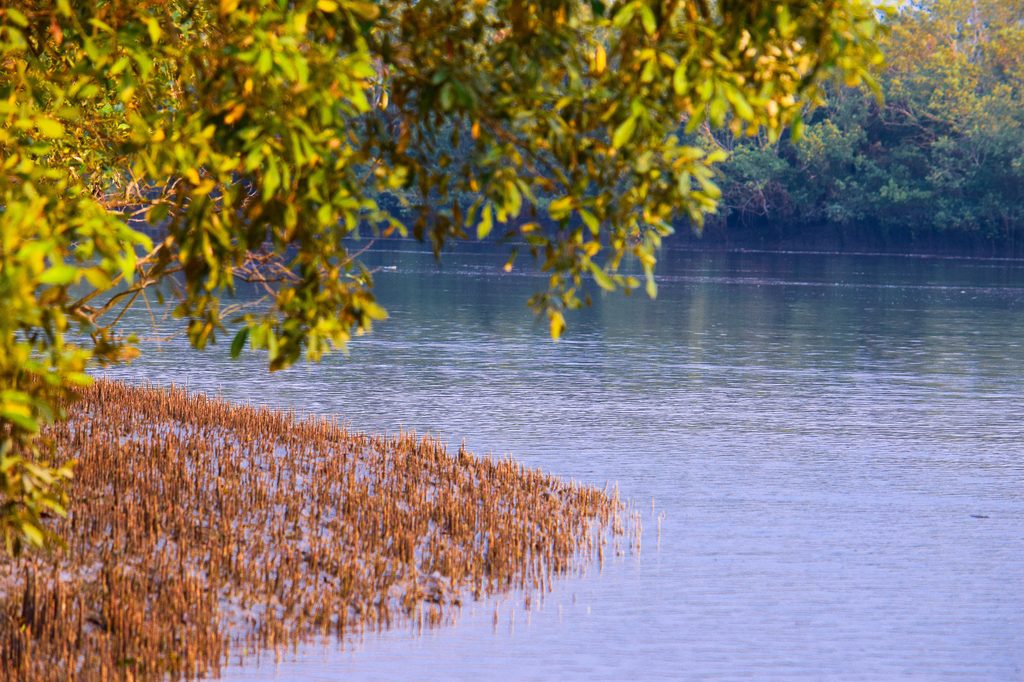
The city gradually dissolved into fields, narrow roads, river crossings and the smell of wet earth. In that village, life moved to another rhythm – slower perhaps, but also harder and more dependent on one another. The wedding was held together by many hands. Neighbours cooked, men arranged chairs, women sang, and children ran barefoot through the afternoon. Poverty was visible, but so was a social wealth that Kolkata often conceals: the assurance that, in a difficult hour, somebody will come and stand beside you.
I remember eating a simple meal and feeling richer than I had at many city dinners. The rice was ordinary. The generosity was not. I was meeting the Indian edge of the world’s largest delta through a human invitation, and that first welcome has remained with me. Even now, I understand the Sundarbans through people before postcards, through the hands that cook, row, teach, repair and endure.
The Delta Stayed With Me
I returned many times after that first journey. The number may now be more than fifty, but counting visits does not explain what the place has done to me. Each journey altered the picture I had carried back from the previous one. The Sundarbans was never only the forest, never only the tiger, the river or the tide. It was a mother waiting for news of a boat, a child trying to keep a notebook dry, a teacher opening a classroom after a storm, a family rebuilding a wall before it had recovered from the last one.
There is a word for the feeling that makes another person’s suffering impossible to treat as somebody else’s problem: pathos. It is often described as an appeal to emotion, but in the Sundarbans I have understood it as something more demanding than sentiment. It is the moment when a damaged roof becomes a child’s lost school day, when a saline pond becomes a family’s shrinking food supply, and when a mangrove becomes the thin living line between a home and the sea. Feeling becomes an obligation to know, and knowing becomes a responsibility to act with humility.
That emotional connection is a large part of how I came to own up to my responsibility toward the Sundarbans. I do not own the land. I do not speak for its people. The place slowly entered my moral geography, and its pain began to feel personal without ever becoming mine to possess. My background, my teachers and my education had prepared me to recognise an injustice. The people of the delta taught me that recognition is only the beginning.
The Day Maa Said Okay
Years later, during the strange half-opening of India after the first lockdown, I asked my mother if she would come with me to a school in the Sundarbans. She had been confined at home for months. I promised a careful drive, no crowds and a slow return. I told her she would see water, forest land and Sundari trees. She listened and said, simply, ‘Okay. Let us go.’ I did not know that this small consent would become one of the most important sentences of my life.
On November 1, 2020, Maa sat in the back seat wrapped in a shawl. She told me to drive slowly and not overtake. ‘This is not the time to prove anything,’ she said. I still hear her voice when I am impatient. As Kolkata fell behind us, the sky widened. Buildings gave way to fields, water and the long, patient green of Bengal. The Sundarbans seemed to exist halfway between soil and river, with the borders between land and water forever being redrawn.
The school did not look like a school when we arrived. Cyclone Amphan had torn away part of the asbestos roof, and the pandemic had emptied the classrooms. There were no children, no laughter and no roll call. Yet a few stubborn people were refusing to let the school die. Jaikrishna Haldar, its founder, spoke quietly: ‘This school will start again.’ He sounded like a caretaker refusing to abandon a child.
Maa walked through the broken corridors and asked how long the school had been shut. ‘Since COVID,’ I said. ‘And Amphan finished what COVID started.’ She nodded. Then she gave the tragedy its most exact description: ‘Children will suffer quietly. Adults will pretend they do not know.’ The sentence has stayed with me because it did not ask for pity. It asked adults to accept responsibility.
Next to the school was a small manmade mini Sundarban – six ponds, trees, mangroves and Sundari plants, protected through community labour. Maa touched the leaves, plucked a little flower and smiled. I took a photograph of her in the sunlight, calm and alive. When I look at it now, I see more than a mother enjoying a day outside. I see the last full journey I made with her. We returned to Kolkata, fell ill with COVID, and on November 24 she was gone.
A Dying Wish From Maa Became a Promise
Before she was taken to hospital, Maa gave me five wishes: travel more, complete my work, look after my health, do not grow old in loneliness, and do something for the school we had just visited. The last wish was spoken without drama. That was its power. A mother who had spent her life caring for others was placing one small unfinished responsibility in my hands.
On her first death anniversary in November 2021, I returned to the Sundarbans. I invited nearly five hundred villagers to a feast in her memory. We ate, remembered and allowed grief to become communal. Women served rice with practised generosity. Children ran barefoot between the adults, carrying on with the authority of life. They did not know that, for me, every face in that gathering was part of Maa’s final instruction.
Out of that grief came the Smt Anu Chowdhury Memorial Educational Foundation. We adopted Vivekananda Adarsha Vidyalaya, run by Vivekananda Sangha in Sankijaan village in the Kultali police station area. The school did not become a monument to my mother, and certainly not to me. It remained what it had always been: a village’s claim to its children. The work began with listening to teachers, families and students, and with accepting that a damaged school needs continuity more than ceremony.
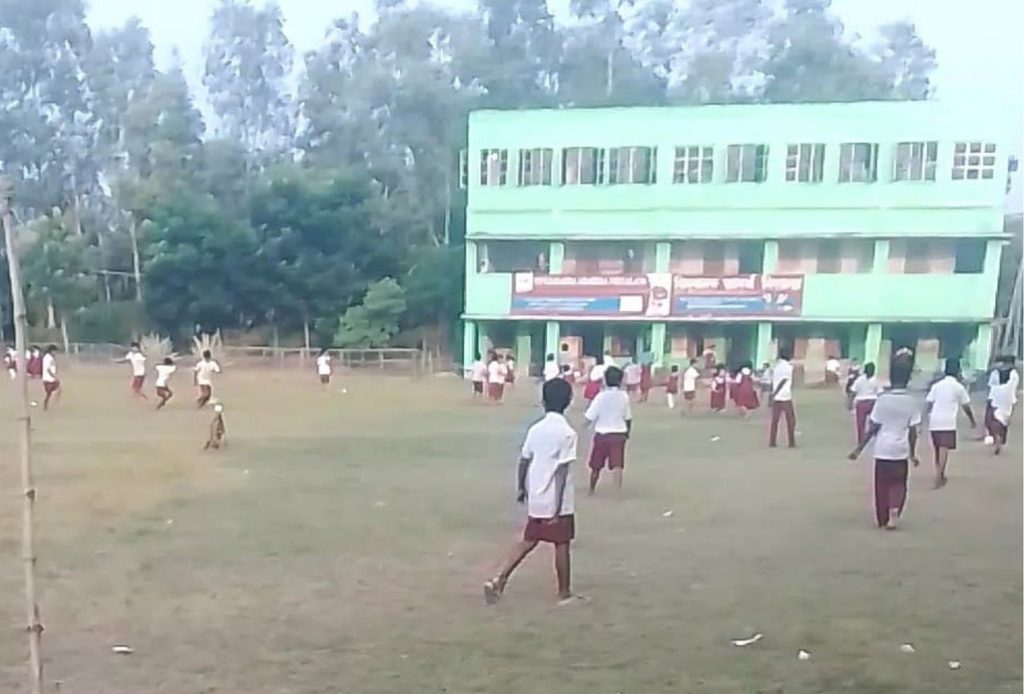
A school bell in a village announces something larger than the beginning of a class. It says that the children are still here, that learning has not been washed away, and that their future will not be surrendered quietly to poverty, storms or migration. The promise I made after Maa’s death has meaning only when the school becomes stronger in the hands of the community.
A School Is a Living Ecology
At Kultali, I have slowly learned that grassroots education cannot be separated from the ecology and economy around it. A child who learns about water should be able to understand the salinity of the family pond. A child who studies the weather should know what a cyclone warning means. A child who learns digital skills should also know how to use digital finance safely. A young person who loves the mangrove should be able to imagine a livelihood that does not require abandoning home in desperation.
The education we are trying to support is therefore holistic and rooted in place. It combines foundational learning with respect for the local language and culture, ecology, arts, sports, digital exposure, community learning and everyday sustainability. It is value-based without being moralising, nature-based without becoming a field trip, and participative enough for a child to ask questions that an adult may not have anticipated. The aim is not to burden children with every problem of the delta. It is to give them knowledge, confidence and choices.
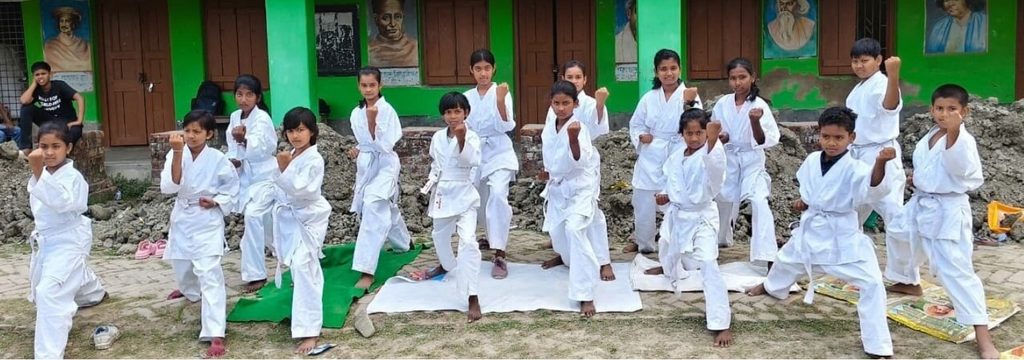
Teachers carry much of this work. They need training, professional dignity and the freedom to help children learn beyond memorised answers. A school cannot become resilient if its teachers are left alone after every cyclone to reconstruct both the roof and the learning process. The community, too, must see the school as its own institution. Parents who fish, cultivate land, work as agricultural labourers or migrate for income carry knowledge that belongs in a child’s education.
The work is now gradually extending from Kultali towards Jhorkhali and Sagardweep, where two more schools are being supported in the process. This is a small beginning, and it remains unfinished. But its direction matters. The purpose is to build a connected culture of learning in which children in different corners of the delta can study, create, stay safer and see dignity in their own surroundings. The expansion is not about spreading a name. It is about widening the circle of children who are allowed to imagine a future.
A Delta Negotiating With the Future
When I return now, I cannot see the Sundarbans only as beauty. I see a place negotiating with the future every day. The danger is not one dramatic morning when the ocean swallows everything at once. It is the slow loss of a field, a pond, a tree, a home, a village and a memory. Sea levels in the Bay of Bengal are rising, land is subsiding in places, fresh sediment is not reaching every part of the delta, embankments weaken, and salinity enters ponds and fields. Storms arrive with greater force and leave behind years of recovery work.
Research projections have warned that roughly 60 to 80 percent of India’s mangrove area could be at risk by the end of this century if sea-level rise, erosion and salinity continue unchecked. The range should not be used as a prop for either panic or denial. It should be treated as a summons to prepare. The Sundarbans may drown in pieces before it disappears from a map: a saline pond, a child leaving school after a parent migrates, a young woman lured away when a storm destroys household income. Ecological loss and human loss are one entangled story here.
Preventing that future will require more than concrete and more than plantation photographs. Tidal creeks must be reopened where they have been blocked, and mangroves must be restored with native species in the right places. Natural regeneration should be protected wherever mud and water can do the work. Low-cost living shorelines, including silt-trapping terracotta rings, deserve serious expansion. Embankments will still be necessary in many places, but they must work alongside the natural shield rather than replace it.
Homes and schools need raised foundations and safe shelters need to be designed into village life. Where land is truly vanishing, relocation must be dignified, voluntary and planned around livelihoods, schooling and social ties. The region needs a Bengal Delta Commission with a long-term resilience fund, transparent data and a strong role for local communities. Kolkata must understand that the safety of the Sundarbans is part of its own safety. The city breathes behind a delta that it rarely sees.
Tourism Must Arrive Lightly
I think often about the beauty and possibility of Jhorkhali and Sagardweep. Jhorkhali is a natural gateway to the delta, where river routes, village life and mangrove landscapes can meet visitors. Its attraction should not be turned into a noisy picnic spot or a row of concrete resorts. The real experience is quieter: a boat slipping through a channel, a bird lifting from the bank, a local guide explaining the tides, and a meal cooked by a family that knows the soil and river because it has lived with both.
Sagardweep carries another kind of beauty. It is where the Ganga meets the Bay of Bengal, where the Kapil Muni shrine, the beach, pilgrimage and coastal ecology share one fragile island. Birdwatching, village walks, local food, craft and mangrove interpretation can create income beyond a short pilgrimage rush. They can also help visitors understand that the island is not an empty stage waiting for development. It is a lived landscape with its own limits and memory.
Tourism should follow the carrying capacity of the place. Boats should be licensed and limited, fuel and noise pollution controlled, sewage treated, plastic refused and sensitive habitats kept out of bounds. Small homestays, community kitchens, boat cooperatives and women-led enterprises can keep money in the villages. Local people should be hosts with rights, not scenery for someone else’s weekend. Their music, food, craft and stories should remain living community traditions, not performances stripped of meaning for tourists.
A transparent share of tourism revenue should return to mangroves, schools, clean water and disaster preparedness. After more than fifty journeys through Kultali, Jhorkhali and Sagardweep, I am convinced that the Sundarbans can become more secure through mindful eco-tourism, but only if tourism learns restraint. The forest should be allowed to remain a little shy. The most successful visit may be the one that leaves the visitor changed and the village no poorer.
Let the Mangroves Earn for the People
The mangroves are living infrastructure. Their roots hold mud, slow waves, shelter fish and protect the edge of the land. Their wood, leaves and waterlogged soil store carbon for long periods. When that carbon is measured, protected and independently verified, it can become part of a blue carbon economy. In plain language, the world can pay the people of the Sundarbans to keep mangroves alive, provided the money is honest and the community is not treated as a labourer on its own land.
One site-specific study cited in carbon research measured nearly 28 tonnes of carbon dioxide equivalent being absorbed each year in mangrove stem biomass per hectare. As an illustration rather than a promise, a 1,000-hectare project at that rate could represent about 28,000 tonnes of credits a year. At an indicative 15 to 35 US dollars per credit, the gross climate value might be roughly 0.4 to 1 million US dollars annually before verification, monitoring, market changes, transaction costs and community payments. The figures are meaningful only if the people who protect the forest share fairly in the value.
Carbon farming must not become a new form of exploitation. Existing forests must be protected as carefully as degraded areas are restored. Each site needs its water movement, soil, salinity and natural species understood. Planting the wrong trees for a report can waste money and trust. Carbon rights must be clear, communities must give informed consent, and independent auditors must verify claims. Benefit-sharing should be simple enough for a village meeting to understand, with a meaningful share reaching village institutions, women’s groups, nurseries, fishers, honey collectors and young forest monitors.
The income need not come from credits alone. Mangrove honey, sustainable fisheries, fish and crab value addition, guiding, restoration work and local craft can grow around the forest. CSR can support early research and monitoring; carbon revenue can help sustain long-term stewardship. Built patiently, the mangrove can help finance a school, a clinic, clean water and safer livelihoods. Its economic value should strengthen its moral value, never replace it.
Preparedness Is Love Made Practical
In the Sundarbans, disaster preparedness cannot begin when a cyclone has already been named. It has to become ordinary life. Every household should know the safest route to a shelter, keep dry food and water, store medicines and papers in waterproof bags, maintain a charged phone or radio, and keep an emergency kit ready. Panchayats should know who will need help first. Every village should know its evacuation boat, vehicle or raised platform before the wind begins to rise.
Schools can become the heart of this preparedness. Children can learn first aid, water safety, evacuation drills and how to help a grandparent move safely. Teachers, youth groups, fishers, religious leaders, Anganwadi workers and women’s groups can form local response teams. Warnings should travel through community radio, loudspeakers and phones in familiar language. Public buildings must be rebuilt safer, not merely faster. The goal should be zero avoidable deaths, because a poor family should not have to pay for a preventable failure with a life.
I want the school at Sankijaan to teach more than examinations. A young person should be able to test soil and water, understand a weather warning, help in a first response, use digital finance safely and find a livelihood without abandoning home. Green skills, financial literacy, digital confidence and disaster readiness protect the same human being. Resilience is a family knowing what to do before the wind arrives, and knowing that the institutions around it will not disappear when the water rises.
Breaking the Chain of Trafficking
The fight against human trafficking must stand beside the fight against ecological destruction. When a cyclone takes away a boat, a crop or a roof, desperation creates an opening for an agent promising a job or marriage. Male migration leaves many women managing households alone. Remote geography and low awareness can hide the truth until a girl or young woman is far away. Climate pressure can turn a region into a source of trafficking if society looks away.
The response has to be concerted and local. Girls must stay in school and gain real pathways to skills and income. Women, teachers, Anganwadi workers, self-help groups, panchayats and youth clubs should learn to recognise recruitment, verify an employer or marriage proposal, record travel details and report quickly. A bilingual documentary, an illustrated Bangla booklet and women-led meetings can make the invisible visible without shaming survivors. Villages must notice unexplained advances, sudden school dropouts and migration that nobody can trace.
A safe village is not one where nobody leaves. It is one where people leave by choice, with information, documents, a traceable destination and a way home. Survivors need protection, counselling, legal support and respect. Education, local enterprise and disaster resilience are anti-trafficking measures too. When a child has a school, a woman has an income and a family has options after a storm, the trafficker loses power.
The People Who Keep Teaching Me
On one later visit, a Class I girl named Sneha ran up with her ribbon slightly undone. ‘Baro Sir, you have come again,’ she said. I told her I kept coming because she kept showing up. Then she asked whether I also had examinations. When I laughed, she became serious: ‘Then you also study, Sir. Otherwise you will fail.’ In that salt air, a child reminded me that learning is a mutual obligation. I had gone to the school thinking I had something to offer. She sent me back knowing that I still had much to learn.
Debasish Das, one of the young teachers carrying the school forward, once looked at the long list of repairs, attendance, training and donor conversations and said, ‘The tide does not ask if we are overwhelmed. It comes. We adjust.’ I hear capability in that sentence, but I also hear the exhaustion behind it. The people of the Sundarbans have adjusted for generations. Our responsibility is to turn adjustment from a permanent condition of suffering into resilience with choices, institutions and support.
The people who live here are not waiting to be rescued into dignity. They are already producing dignity under conditions that would test anyone. What they need is a fairer share of safety, education, information, opportunity and decision-making power. Any outside effort is worthwhile only when it strengthens that agency and becomes less necessary over time.
The Paper Boat I Carry
Before I left one afternoon, Sneha returned with a paper boat made from an old notebook page. ‘For you,’ she said. I asked why I needed a boat. She answered with the certainty of a child who understands the delta: ‘When water rises, a boat is needed.’ I held it as if it were made of iron.
I want to carry that paper boat as my picture of the Indian Sundarbans. It is not a doomed landscape waiting for pity, and it is not a resource waiting for extraction. It is a living place where education can reduce vulnerability, mangroves can protect and earn, tourism can learn restraint, women and children can be safer, and people can remain in communion with nature without being punished for being poor.
When I look back, the path to the Sundarbans seems to have been made from many small recognitions. The Ramakrishna Mission taught me to value service. Jadavpur University taught me to see the structures behind suffering. The people of Lakhsmikantapur first welcomed me without asking what I could do for them. Maa took me to a wounded school and then left me her dying wish. The children and teachers of Kultali have kept turning that wish into a living question.
Today the work is moving from Kultali towards Jhorkhali and Sagardweep, with two more schools being supported. I speak of this only because the journey is continuing, not because it belongs to me. Every school that opens its doors after a storm, every girl who remains in learning, every family that reaches a shelter in time, and every mangrove allowed to grow is a quiet answer to the fear that the delta has been abandoned.
I do not know whether the Sundarbans can be saved by our generation. I know what saving it must mean: safe homes, functioning schools, protected forests, honest livelihoods, clean water, preparedness before disaster and a voice for the people who live there. Maa’s last wish remains my compass, but the people of the Sundarbans are the ones who show me the direction.
If water rises, a boat is needed. Sometimes it is made of wood. Sometimes it is made of a school, a mangrove, a neighbour’s hand or a child’s stubborn hope. I carry the paper boat because it reminds me that the future of the Sundarbans will not be secured by emotion alone. It will be secured when emotion becomes attention, attention becomes solidarity, and solidarity gives people the power to remain, rebuild and thrive.
Prof. Ujjwal K. Chowdhury is a senior academic, institution-builder, and political analyst based in Kolkata, India.
