
Dr. Kuldeepsingh Rajput
Imagine a young graduate from Buldhana finding opportunities in Akola, a skilled worker from Beed securing employment in Chhatrapati Sambhajinagar, a farmer’s son from Nandurbar choosing Jalgaon, a youth from Washim building a career in Amravati, or a tribal youth from Gadchiroli finding meaningful employment in Chandrapur. The question is: Can Maharashtra develop alternative destination cities and reduce its overwhelming dependence on metro hubs like Mumbai and Pune?
If Maharashtra’s Tier-II and Tier-III cities offered quality employment, affordable housing, efficient public services, and robust infrastructure, migration within the state could become far more balanced. Instead of a handful of metropolitan centres absorbing most migrants, a network of vibrant regional cities could emerge as new engines of economic growth and opportunity. This would not only ease the pressure on Mumbai and Pune by reducing congestion, housing shortages, and stress on urban infrastructure, but also bring jobs and development closer to where people live.
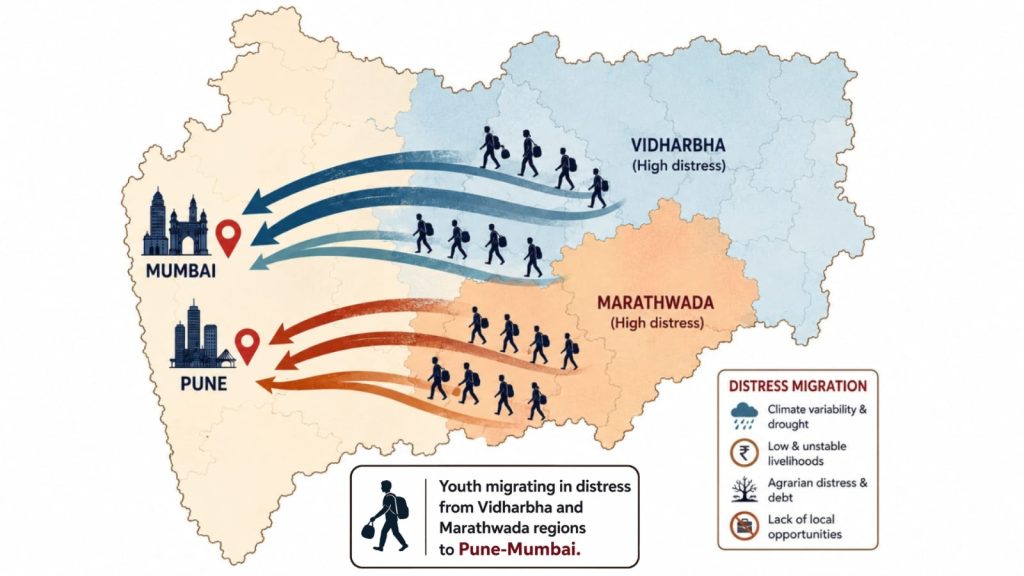
The Urban Challenge Fund (UCF), recently announced by the Chief Minister of Maharashtra, marks a significant step towards strengthening civic infrastructure in small and medium towns with populations below one lakh. If implemented strategically, the Fund has the potential to transform these towns into vibrant economic hubs, promote balanced regional development, and reshape migration patterns across Maharashtra by reducing the excessive concentration of people and opportunities in Mumbai and Pune. The UCF is a centrally sponsored scheme of the Ministry of Housing and Urban Affairs with central assistance of ₹1,00,000 crore for FY 2025–26 to 2030–31, with an extendable implementation timeline up to FY 2033–34.Maharashtra is India’s most urbanised state and one of the country’s largest destinations for internal migrants. Migration has played a significant role in driving the state’s economic growth, but it has also led to a disproportionate concentration of population, employment opportunities, and investments in a few major urban centres such as Mumbai and Pune.
Against this backdrop, the UCF has been introduced at a critical juncture, offering a timely opportunity to strategically invest in smaller, medium and emerging cities, enabling them to evolve into vibrant centres of economic growth and balanced regional development.
Migration: The Blind Spot in Urban Planning
Urban planning and migration are inseparable. Every urban investment is, in effect, a migration intervention. Investments in roads, industrial corridors, public transport, affordable housing, schools, hospitals, and digital infrastructure shape where people choose to live, work, and build their futures. They determine where employment, businesses, quality public services, and economic opportunities are concentrated, thereby influencing migration patterns across the state.
While such investments create new opportunities in some regions, they can also deepen regional imbalances by concentrating growth and capital in a few urban centres. Yet, despite migration being one of the principal drivers of urbanisation, it has rarely been recognised as a core consideration in urban planning or municipal investment decisions. As a result, cities continue to expand without adequately anticipating or managing the demographic, social, and economic consequences of migration, limiting the potential for more balanced and inclusive regional development. If implemented through a migration-sensitive lens, the UCF can become much more than an urban infrastructure financing mechanism. It offers Maharashtra an opportunity to deliberately shape future migration patterns by directing investment towards smaller and intermediate cities with high growth potential. Rather than allowing migration to be driven solely by historical concentrations of jobs and infrastructure in Mumbai and Pune, the Fund can create new centres of economic opportunity across the state. Strengthening these cities with quality infrastructure, public services, and economic ecosystems would enable them to attract investment, enterprises, and skilled workers, easing pressure on existing metropolitan regions while promoting more balanced regional development. In doing so, the Fund can help transform migration from a distress-driven necessity into a genuine matter of choice.
City-centred growth fuels Distress Migration
While the UCF presents a significant opportunity to reshape Maharashtra’s urban future, its design also warrants scrutiny. Two concerns deserve particular attention.
First, the Fund risks reinforcing a city-centred model of development. While strengthening urban centres is important, sustainable regional development cannot rely on cities alone. If investments continue to prioritise urban infrastructure without simultaneously strengthening rural economies, small towns, agriculture, and non-farm livelihoods, the structural drivers of migration will remain largely unaddressed. Balanced development requires creating opportunities not only in destination cities but also in migration source regions. Urbanisation should complement rural development, not substitute for it.
Second, by making selected cities more attractive through concentrated public investment, the Fund may inadvertently trigger new waves of migration and deepen regional imbalances. Better infrastructure, industries, and public services are likely to attract workers from economically weaker districts. While this may reduce pressure on Mumbai and Pune if investments are distributed across Tier-II and Tier-III cities, it could also accelerate outmigration from already lagging regions unless comparable investments are made in rural and backward districts. Without a complementary regional development strategy, the Fund may redistribute migration rather than reduce distress migration or address uneven development.
The UCB should therefore be embedded within a broader regional development strategy that simultaneously strengthens migration source regions, supports rural livelihoods, and develops small and medium towns as growth centres. Only then can it contribute to balanced development rather than creating a new geography of inequality.
Infrastructure alone will not build Inclusive Cities
The UCB should not be judged solely by the infrastructure it creates, but by whether it builds cities that are inclusive for everyone, including migrant workers. Roads, industrial parks, metro systems, and commercial districts are essential, but they do not automatically translate into equitable urban development. The experience of cities such as Mumbai and Pune demonstrates that while infrastructure has expanded rapidly, critical questions surrounding migration have largely remained outside the ambit of urban planning.
Will migrant workers have access to affordable rental housing? Will labour markets become more inclusive? Will social protection be portable across places of origin and destination? Will cities collect reliable migration data? Will municipal development plans recognise the needs and contributions of migrant workers?
These questions have been largely overlooked in urban planning, leaving millions of migrants to navigate cities without adequate housing, social protection, or institutional support. Unless the UCF explicitly addresses these gaps, it risks reproducing the very inequalities it seeks to overcome. Maharashtra’s ambition should therefore extend beyond building infrastructure-driven cities to creating inclusive, migrant-responsive cities where growth is accompanied by dignity, access, and opportunity for all. The UCB offers Maharashtra a historic opportunity to rethink the relationship between urbanisation, migration, and regional development.
Dr. Kuldepsingh Rajput is a Migration Scholar and leads RUBAL FOUNDATION, a non-profit working with migrants and unorganised sector workers.

This Post Has 6 Comments
A truly insightful article on a topic that is often overlooked. The questions raised challenge us to think more critically and articulate our perspectives on migration. Well worth the read!
Thanks Jeslin for your feedback
I completely agree with the author that we should focus on developing smaller cities and reduce burden on Mumbai-Pune centric and it’s thought provoking that we must focus on migrant workers rather than just building infrastructure.
Thank you Shreya
A thoughtful perspective that prioritizes empowering source regions for a more sustainable solution than simply managing migration flows. Well-articulated 🙌🏻
Thanks Sakshi