
By Somnath Dabhade, Assistant Director, CYDA
Agriculture forms the backbone of Maharashtra’s economy and supports the livelihoods of millions of farmers. The state’s agricultural prosperity depends largely on the Southwest Monsoon, which provides nearly 80 percent of annual rainfall. From the cotton fields of Vidarbha and soybean farms of Marathwada to the sugarcane belts of Western Maharashtra and fruit orchards of Nashik, adequate rainfall is crucial for agricultural productivity.
However, Maharashtra’s dependence on monsoon rainfall also makes it highly vulnerable to climate variability. One of the most significant global climate phenomena affecting the Indian monsoon is El Niño. Although it originates in the Pacific Ocean, thousands of kilometres away from India, its influence extends across continents, affecting rainfall, temperature, and agricultural production. Historically, many drought years in India have been linked to El Niño events. For Maharashtra, particularly drought-prone regions such as Marathwada and Vidarbha, El Niño poses a serious challenge to agriculture, water security, and rural livelihoods.
What is El Niño?
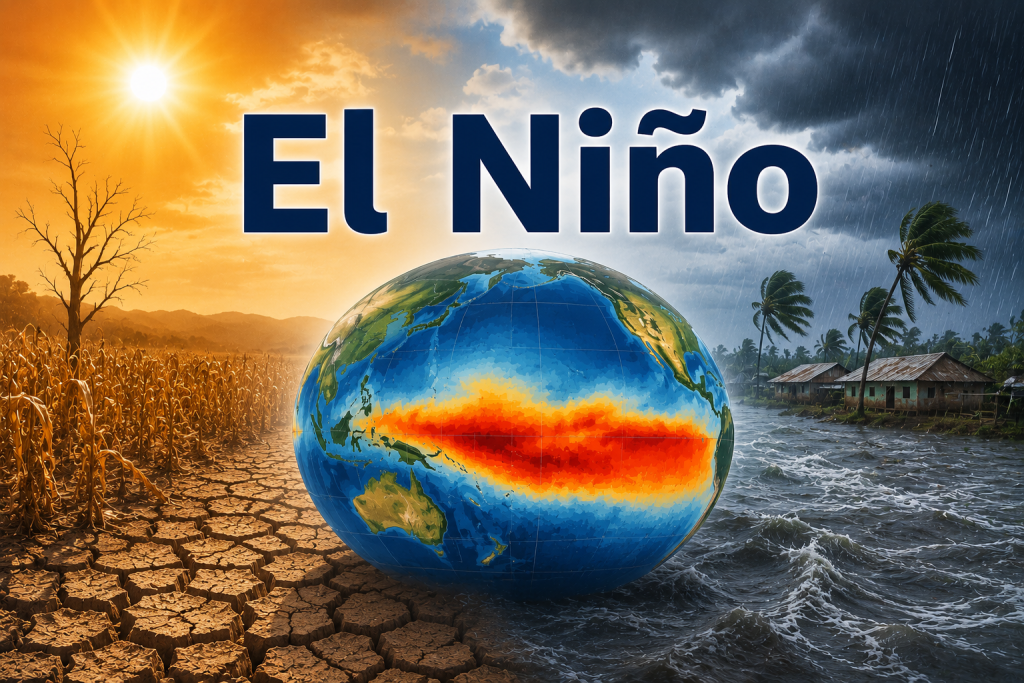
El Niño is a climate phenomenon characterized by the abnormal warming of sea surface temperatures in the central and eastern Pacific Ocean. It is part of a larger climate cycle called the El Niño-Southern Oscillation (ENSO), which consists of three phases: El Niño, La Niña, and Neutral conditions.
Under normal circumstances, strong trade winds push warm ocean water towards Southeast Asia and Australia. During an El Niño event, these winds weaken, allowing warm water to move eastward towards South America. This change alters atmospheric circulation and affects weather patterns across the globe.
As a result, some regions experience heavy rainfall and floods, while others suffer droughts and heat waves. India often experiences weaker monsoon conditions during strong El Niño years. Major El Niño events recorded in 1982-83, 1997-98, 2002, 2009, 2015-16, and 2023-24 caused significant disruptions in agricultural production and water availability.
El Niño and the Indian Monsoon
The Indian monsoon is among the world’s most important weather systems. Nearly three-fourths of India’s annual rainfall is received during the monsoon season. This rainfall supports agriculture, groundwater recharge, hydropower generation, and drinking water supplies.
Scientists have established a strong relationship between El Niño and monsoon variability. During El Niño years, the monsoon circulation tends to weaken, resulting in below-normal rainfall across many parts of India. Even when total seasonal rainfall appears normal, long dry spells and uneven rainfall distribution can severely affect agriculture.
Since Maharashtra depends heavily on monsoon rainfall, any weakening of the monsoon can have widespread consequences.
Why Maharashtra and Vidarbha are Highly Vulnerable
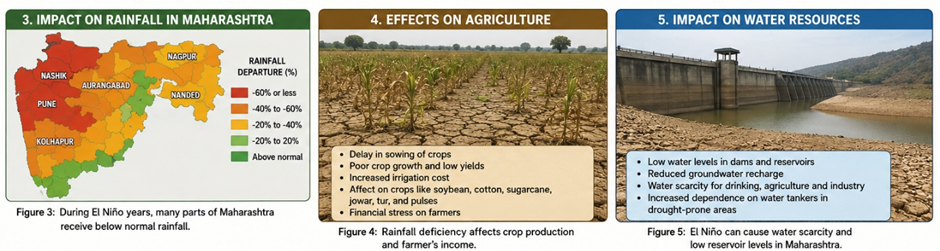
Maharashtra has diverse climatic conditions. While the Konkan region receives abundant rainfall, regions such as Marathwada, Vidarbha, and parts of Western Maharashtra frequently experience droughts and water stress.
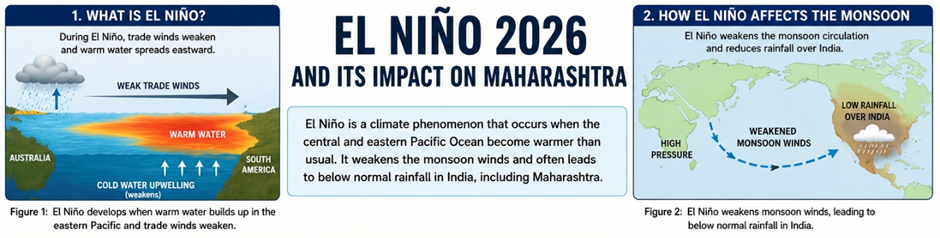
More than half of Maharashtra’s cultivated land remains rain-fed. Farmers often rely directly on monsoon rainfall rather than irrigation facilities. Consequently, monsoon failure immediately affects agricultural productivity and rural incomes.
Major crops cultivated in Maharashtra include:
- Cotton
- Soybean
- Sugarcane
- Tur (Pigeon Pea)
- Jowar
- Bajra
- Groundnut
- Grapes
- Pomegranates
- Mangoes
- Oranges
The productivity of these crops is closely linked to rainfall availability and distribution.
Impact on Agriculture
Agriculture is the sector most severely affected by El Niño.
Cotton Production
Maharashtra is India’s largest cotton-producing state. Cotton requires adequate moisture during flowering and boll development. Prolonged dry spells can significantly reduce yields and fibre quality, affecting farmers’ incomes.
Soybean Cultivation
Soybeans are a major commercial crop in Marathwada and Vidarbha. Insufficient rainfall during the sowing and pod development stages often results in poor yields and economic losses.
Sugarcane Sector
Sugarcane is a water-intensive crop. During drought years, irrigation reservoirs receive less water, forcing farmers to reduce irrigation frequency. This lowers productivity and affects sugar industries.
Horticulture
Maharashtra is known for grapes, pomegranates, mangoes, and oranges. Water stress can reduce fruit quality, size, and export potential, causing substantial financial losses.
Food Grains and Pulses
Tur, jowar, and bajra are important food crops. Reduced rainfall lowers production, affecting food security and increasing market prices.
Water Scarcity and Groundwater Depletion
One of the most serious consequences of El Niño is water scarcity.
Reduced rainfall leads to:
- Declining reservoir storage.
- Reduced river flows.
- Poor groundwater recharge.
- Drying of wells and borewells.
Districts in Vidarbha and Marathwada frequently experience drinking water shortages during drought years. Water tankers often become the primary source of drinking water for villages.
Overexploitation of groundwater further worsens the situation. Falling water tables increase irrigation costs and threaten long-term water sustainability.
Impact on Livestock
Livestock farming provides an important source of income for rural households. During El Niño-induced droughts, farmers face shortages of fodder and water.
Consequences include:
- Lower milk production.
- Reduced animal productivity.
- Increased disease incidence.
- Higher feed costs.
- Distress sale of cattle.
These losses significantly affect the economic security of farming families.
Heat Waves and Human Health
El Niño is often associated with higher-than-normal temperatures. Maharashtra may experience more intense and prolonged heat waves during such periods.
High temperatures:
- Increase crop water requirements.
- Reduce labour productivity.
- Increase evaporation losses.
- Raise electricity demand.
- Affect public health.
Agricultural labourers, elderly citizens, women, and children are particularly vulnerable to heat-related illnesses.
Environmental Consequences
The effects of El Niño extend beyond agriculture and water resources. El Niño can have several environmental and economic impacts. Reduced rainfall and water availability affect rivers, wetlands, and aquatic ecosystems, leading to a decline in fish populations and biodiversity. Dry conditions also increase the risk of forest fires, particularly in drought-prone areas. Low soil moisture and reduced vegetation cover can cause soil erosion and land degradation. Prolonged drought places stress on ecosystems, damages wildlife habitats, and reduces their ability to recover from environmental changes. Economically, El Niño can result in significant losses, especially in agriculture. Lower crop production reduces farmers’ incomes and affects agricultural growth. Reduced food production can also lead to higher food prices, increasing the financial burden on consumers.
Government Expenditure
Governments must allocate substantial funds for:
- Drought relief.
- Water tanker services.
- Crop insurance compensation.
- Rural employment programs.
Industrial Impact
Industries dependent on water resources may face operational challenges due to water shortages.
Rural Debt
Crop failures often force farmers to borrow money, increasing indebtedness and financial stress.
Social Consequences
El Niño-related droughts create several social challenges. Many rural families migrate to urban areas in search of employment when farming becomes unprofitable. Such migration places pressure on urban infrastructure and public services. Women often face additional burdens during water shortages as they are primarily responsible for collecting water for household use. Financial stress can also affect health, education, and overall quality of life in rural communities.
Role of Government in Managing El Niño Impacts
The Government of Maharashtra and the Government of India play a crucial role in helping farmers and communities cope with climate-related risks.
Weather Forecasting and Early Warning
Agencies such as the India Meteorological Department (IMD) provide weather forecasts and advisories that help farmers make informed decisions.
Water Conservation Programs
Important initiatives include:
- Jalyukt Shivar Abhiyan
- Atal Bhujal Yojana
- Jal Jeevan Mission
- Watershed Development Programmes
These schemes promote groundwater recharge, rainwater harvesting, and water conservation.
Promotion of Micro-Irrigation
Government subsidies encourage farmers to adopt drip and sprinkler irrigation systems, which improve water-use efficiency.
Crop Insurance
The Pradhan Mantri Fasal Bima Yojana (PMFBY) provides compensation to farmers affected by droughts and crop failures.
Agricultural Research
Agricultural universities and research institutions develop drought-resistant crop varieties and climate-smart farming practices.
Role of Civil Society Organizations (CSOs)
Civil Society Organizations play a vital role in strengthening community resilience.
Farmer Awareness and Training
CSOs conduct training on:
- Water conservation.
- Climate-smart agriculture.
- Soil health management.
- Sustainable farming practices.
Watershed Development
Many NGOs support watershed projects, afforestation, groundwater recharge, and the restoration of village ponds.
Promotion of Farmer-Producer Organisations
CSOs help establish Farmer-Producer Organisations (FPOs) that improve farmers’ access to markets, technology, and financial services.
Emergency Support
During droughts, NGOs provide drinking water support, livestock care, and livelihood assistance to vulnerable communities.
Policy Advocacy
CSOs advocate for sustainable water management, farmer welfare, and climate-resilient development policies.
Adaptation Strategies for a Resilient Maharashtra
To reduce vulnerability to El Niño, Maharashtra must adopt climate-resilient approaches.
Key strategies include:
- Rainwater harvesting.
- Farm ponds and check dams.
- Drip and sprinkler irrigation.
- Drought-resistant crop varieties.
- Crop diversification.
- Soil moisture conservation.
- Improved weather forecasting.
- Community participation in water management.
These measures can significantly reduce the impacts of drought and improve agricultural sustainability.

El Niño is not merely a climatic phenomenon but a major challenge to Maharashtra’s agriculture, water security, and rural economy. Reduced rainfall, water scarcity, crop failures, livestock losses, heat waves, and economic hardship are among its most serious consequences. Regions such as Marathwada and Vidarbha remain particularly vulnerable due to their dependence on rain-fed agriculture.
However, the impacts of El Niño can be minimized through scientific planning, efficient water management, climate-smart agriculture, and strong collaboration between governments, civil society organizations, research institutions, and farming communities. By investing in resilience today, Maharashtra can secure its agricultural future and protect the livelihoods of millions of farmers.
“While El Niño is a natural phenomenon, its impacts need not become a disaster. Through science, sustainable water management, and collective action, Maharashtra can transform climate challenges into opportunities for resilience and growth.”