
By Pramodini Naik, Assistant Director, CYDA
The recent report released by NITI Aayog titled “School Education System in India: Temporal Analysis and Policy Roadmap for Quality Enhancement” presents a comprehensive overview of the current status of school education in India. The report analyses educational progress and challenges across the country using data from UDISE+, National Achievement Survey (NAS), Annual Status of Education Report (ASER), and other government educational databases (NITI Aayog, 2026). The objective of the report is to identify gaps in access, quality, retention, and equity while recommending reforms for strengthening India’s school education system.
Basis of the Report
The report is based on indicators such as Gross Enrolment Ratio (GER), dropout rates, school infrastructure, learning outcomes, and teacher availability at the primary, secondary, and higher secondary levels. It studies educational trends over the last decade and compares the performance of government and private schools across different states (NITI Aayog, 2026). One of the major observations of the report is that while India has achieved significant progress in school access and enrolment at the elementary level, continuity in secondary and higher secondary education remains weak (The Times of India, 2026).
Gross Enrolment Ratio and Educational Status
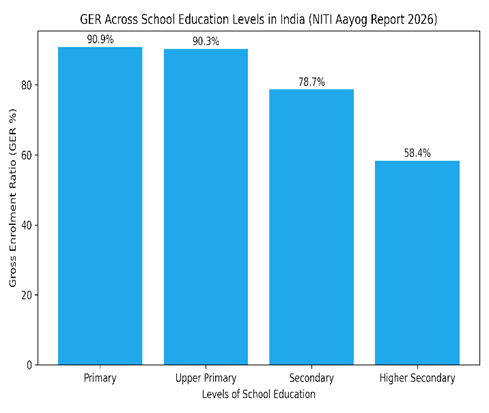
The report highlights that India has achieved near-universal enrolment at the primary level, with the Gross Enrolment Ratio (GER) crossing 90 percent in many states. However, the enrolment gradually declines as students move to higher classes. According to the report, the GER falls to around 78.7 percent at the secondary level and decreases further at the higher secondary stage (NITI Aayog, 2026). The report identifies secondary education as the most vulnerable stage in the education system due to increasing dropout rates. Nearly 11.5 percent of students discontinue their education during secondary schooling, while a large proportion of students fail to complete higher secondary education (The Times of India, 2026).
These findings strongly connect with the field experiences of the Centre for Youth Development and Activities (CYDA) through its Better Learning Program in Dahanu. CYDA has observed that dropout rates sharply increase after Grade 8, especially among tribal students and girls living in remote areas. One of the major reasons is the long distance between secondary schools and tribal padas or hamlets. Families struggling for a livelihood often cannot afford transportation facilities for their children. In many cases, parental disinvolvement, lack of educational guidance, and economic hardship force children to discontinue education.
The recent Government Resolution (GR) by the Education Department of Zila Parishad, Palghar, on 30th April 2026, regarding the closure of Grades 9 and 10 in Zilla Parishad schools has further intensified concerns regarding educational access in the tribal area of Palghar. Although the decision was later withdrawn following pressure from local leaders, teachers, and communities, the proposal exposed a dangerous policy direction. The suggestion that free education under RTE should effectively remain only up to Grade 8 would have pushed thousands of vulnerable children out of the education system.
Reasons Behind Dropouts
The report identifies several reasons behind rising dropout rates in secondary and higher secondary education. Economic hardship, lack of transportation, distance from schools, early marriage, gender discrimination, weak learning foundations, and poor parental support are among the key factors affecting student retention (NITI Aayog, 2026). CYDA’s experience in Dahanu reflects these realities. Many students from tribal communities face challenges in accessing nearby secondary schools. For girls, safety concerns and long travel distances become additional barriers. Families prioritizing daily income and survival often fail to continue their children’s education beyond Grade 8.
Another major issue identified by both the report and CYDA’s field experience is the shortage of teachers and excessive non-teaching workload. Teachers are frequently involved in administrative work, election duties, surveys, and data management, which reduces their focus on classroom teaching and student engagement. This affects the quality of the teaching-learning process in both rural and urban schools.
Shift from Government to Private Schools
The NITI Aayog report highlights a steady shift from government to private schools in India. Although government schools still constitute nearly 68 percent of total schools, enrolment declined from 54.3 percent in 2014-15 to 49.2 percent in 2024-25, while private school enrolment increased from 31.7 percent to 38.8 percent during the same period (NITI Aayog, 2026; The Indian Express, 2026). The report attributes this trend to teacher shortages, poor infrastructure, weak accountability, and learning gaps in government schools. It also notes that over one lakh schools operate with a single teacher (NDTV, 2026). This transition increases educational inequality for economically weaker families.
Conclusion
The NITI Aayog Report 2026 presents a critical picture of India’s school education system. While the country has made remarkable progress in improving enrolment and access at the primary level, challenges related to retention, quality education, and secondary schooling continue to persist. The report clearly indicates that improving secondary and higher secondary education should become a national priority. Experiences from CYDA organizations demonstrate that educational challenges in tribal and remote areas require localized and community-based solutions. Better teacher recruitment, reduction in non-teaching duties, transportation support, parental engagement, and strengthening of government schools are essential to reduce dropout rates and ensure that every child receives quality education with dignity and opportunity.
References
- NDTV. (2026). Over 1 lakh schools lack power, toilets and teachers: NITI Aayog report. Retrieved from https://www.ndtv.com/india-news/government-schools-lack-electricity-water-girl-toilet-teachers-math-skill-digital-education-niti-aayog-report-11465851
- NITI Aayog. (2026). School Education System in India: Temporal Analysis and Policy Roadmap for Quality Enhancement. Government of India. Retrieved from https://www.niti.gov.in
- The Indian Express. (2026). Private over govt schools, falling enrolment and dropout rates: Where India’s school education system stands. Retrieved from https://indianexpress.com/article/explained/india-school-education-trends-niti-aayog-private-govt-enrolment-10684378/
- The Times of India. (2026). NITI report says school access up, continuity weak. Retrieved from https://timesofindia.indiatimes.com/india/niti-report-says-school-access-up-continuity-weak/articleshow/131000930.cms/
