
Suryakant Chavan, Watershed Expert, CYDA
Diksal village in Sangola block is known for its drought-prone conditions, where farming has always been a struggle. With an average annual rainfall of only 623 mm (2025) and groundwater levels dropping to around 5 meters below ground level, farmers usually faced continuous problems and an unpredictable future. Most of the rainwater would quickly run off due to sloping land, leaving very little for groundwater recharge. Over time, this led to severe soil erosion, loss of fertile topsoil, and declining agricultural productivity. Many farmers depended heavily on external water sources, and crop failures were common. Productivity was low, and farming was mostly limited to a single Kharif season. The situation became increasingly difficult for farmers, as noted by Suryakant Chavan, Watershed Expert, Sangola. “Earlier, my land was barren and not suitable for cultivation due to the slope. During rains, fertile soil used to get washed away and very little water stayed back,” shared one farmer.
To address these challenges, Centre for Youth Development and Activities introduced Continuous Contour Trenches (CCTs) under the Comprehensive Village Development Programme (CVDP) with support from SBI Mutual Fund. Farmers and Village Development Committee (VDC) members identified suitable land patches under this initiative. A watershed expert then verified the sites, marked contour lines based on land slope and guided the excavation. Using machines, trenches have been dug along these contours to slow down water flow and allow it to seep into the soil.
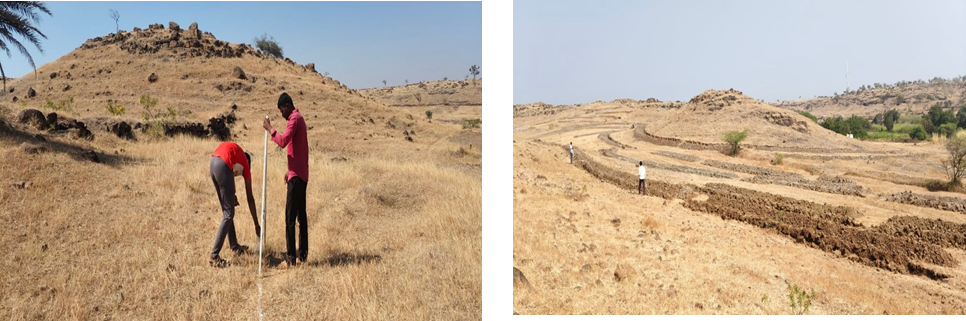
A total of 12,247 cubic meters of CCTs were constructed across 65.13 hectares, benefiting 25 farmers directly. This intervention brought measurable improvements.
- Surface runoff reduced by nearly 30–40%, allowing more water to percolate into the ground.
- Soil erosion reduced by about 35%, helping retain fertile topsoil.
- Groundwater levels showed seasonal improvement after the rains
- Dependency on external water sources reduced by 20%.
The intervention has had a significant impact on farmers’ lives with visible improvements bringing a sense of satisfaction and confidence among them.
“After the construction of CCT on my land, the flow of rainwater has slowed down and the fertile soil is now retained. Water gets stored and gradually recharges groundwater. I am very happy to see this positive change,” shared Appaso Bhusnar from Diksal village.
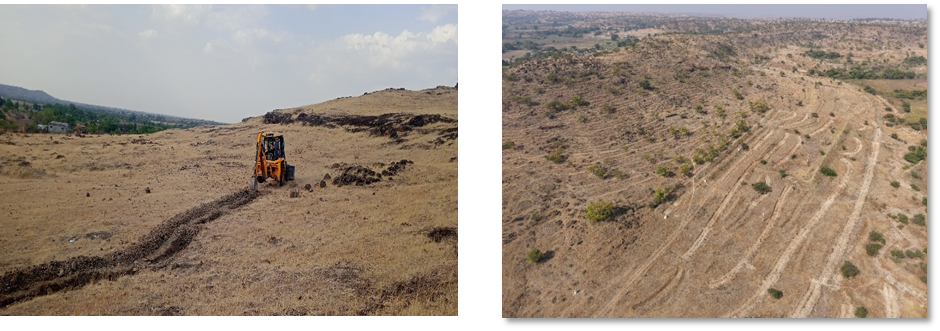
With improved water availability, farmers can now grow Rabi and summer crops like gram, jowar and wheat, instead of relying only on Kharif crops. This has increased their income and made them stronger against drought. On the ground, visible changes can be seen. Trenches hold rainwater for longer periods; wells have better water levels and soil quality has improved. Even downstream water structures benefit from reduced silt flow, increasing their lifespan.
Sustainability is also ensured through regular maintenance like desilting before monsoon, repairing berms, and planting grasses along trench edges to strengthen the structure. The CCT intervention conserved water and also restored hope, improved livelihoods and built resilience for the future.
