
Mathew Mattam
The debate around the proposed amendment to the Foreign Contribution (Regulation) framework has brought to the surface a deeper and more uncomfortable question: Is this about transparency, or is it about control?
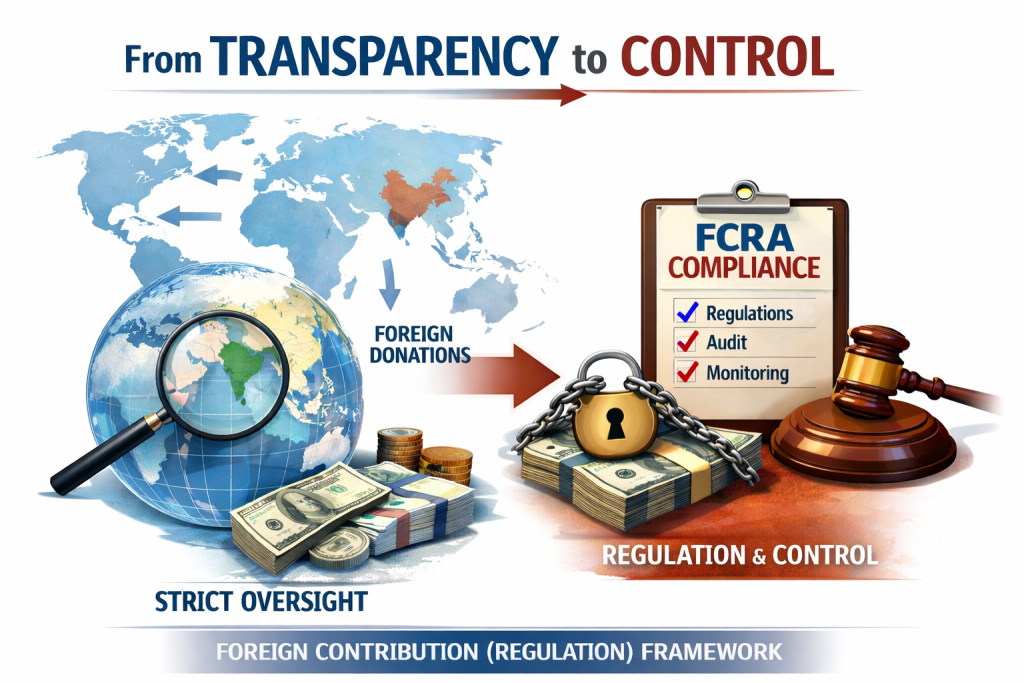
For decades, India has had laws regulating foreign contributions. These laws were designed to ensure that external funding does not undermine national interest, public order, or sovereignty. Few would disagree with the need for such safeguards. However, what is now being proposed appears to move far beyond regulation. It introduces a framework that raises serious concerns about the shrinking space for civil society and the vulnerability of institutions—particularly those built by minority communities.
From Transparency to Control
At first glance, the amendment is presented as a corrective measure—aimed at addressing “administrative gaps” and ensuring better supervision of foreign funds. But a closer reading suggests something far more consequential.
The introduction of a “designated authority” with sweeping powers to take over, manage, and even dispose of assets of organisations whose registrations lapse, are denied renewal, or are cancelled marks a fundamental shift. This is not merely regulatory oversight—it is structural control.
The most troubling aspect is the automatic transfer of assets. Once an organisation loses its registration, its assets—often built over decades—can be taken over without a judicial process. This includes assets only partially created through foreign contributions.
This raises a fundamental question: Is the objective to regulate funds, or to control institutions?
A Disproportionate Response
Every law must follow the principle of proportionality. Minor procedural lapses should not lead to irreversible consequences.
Under the proposed amendment, even delays in renewal, administrative errors, or technical non-compliance could potentially result in the loss of institutional assets. Schools, hospitals, community centres, and social infrastructure built through years of public service could be placed under state control.
Such disproportionate consequences do not strengthen compliance—they create fear.
When regulation becomes punitive rather than corrective, it stops being a governance tool and begins to resemble a mechanism of pressure.
The Question That Must Be Asked: Why the Fear of Foreign Funds?
One of the most important questions in this entire debate is rarely addressed directly:
Why is there such deep concern about foreign contributions to civil society?
Foreign funding to India is not new. It has supported education, healthcare, disaster relief, and social development for decades. Thousands of organisations—many working in the most underserved and remote parts of the country—have depended on such support to fill critical gaps.
If the concern is misuse, then the answer lies in stronger auditing, transparent reporting, and accountability systems—not in the takeover of assets.
If the concern is national security, then targeted intelligence and enforcement mechanisms already exist.
But if the response is to centralise control over institutions themselves, it raises doubts about whether the intention is truly regulatory.
Civil Society as a Democratic Pillar
Civil society is not an adversary of the state. It is a partner in nation-building.
Across India, non-governmental organisations have worked where state systems struggle to reach—tribal belts, disaster-hit regions, informal urban settlements, and marginalized communities. They run schools, health programs, livelihood initiatives, and social justice campaigns.
More importantly, they act as voices of the people—highlighting gaps, advocating for rights, and contributing to public dialogue.
When such institutions are placed under constant threat of administrative takeover, their independence is compromised. Their ability to question, innovate, and respond to community needs is weakened.
This is not just about organisations—it is about the health of democracy itself.
Minority Institutions and Emerging Concerns
Another layer of concern emerges from the potential impact on institutions run by minority communities, particularly those that have historically relied on foreign contributions for social and charitable work.
Many such institutions—schools, hospitals, care centres—have been built over generations. They serve not only specific communities but society at large, often in regions where alternatives are limited.
The possibility that these institutions could lose control over their assets due to administrative decisions creates a deep sense of insecurity.
Even if the law does not explicitly target any community, its design and implications raise concerns about selective vulnerability.
In a diverse country, laws must be especially careful not to create conditions that disproportionately affect certain groups.
Centralisation Without Adequate Safeguards
The amendment also concentrates significant power in the hands of a centrally appointed authority. This authority can supervise, manage, transfer, or dispose of assets.
However, the safeguards around this power remain unclear.
Where is the independent oversight?
Where is the judicial review before asset transfer?
Where are the clear timelines and appeal mechanisms?
Without these, the system risks becoming opaque and unaccountable.
In a federal democracy, the concentration of power without checks creates an imbalance.
Transparency Cannot Be Selective
If the intent of the amendment is transparency, then transparency must apply across the system.
Recent concerns about the lack of publicly accessible data on FCRA registrations, renewals, suspensions, and cancellations point to a larger issue. When information itself becomes difficult to access, it weakens trust.
Transparency is not achieved by increasing control over organisations—it is achieved by making systems open, data accessible, and decisions accountable.
A regulatory framework that demands compliance must also demonstrate openness.
A Pattern of Shrinking Space?
Viewed in isolation, the amendment may appear as a technical legal change. But when seen in the context of broader regulatory trends, it raises concerns about the gradual shrinking of space for independent civil society action.
Stricter compliance norms, increased scrutiny, and now the possibility of asset control together create an environment where organisations may struggle to function freely.
The question is not about one amendment—it is about the direction of policy.
Are we moving toward a system that encourages collaboration between state and society?
Or toward one that places civil society under continuous surveillance and control?
Conclusion: A Moment for Reflection
India’s strength lies in its diversity—of people, institutions, and ideas. Civil society is an essential part of this diversity. It bridges gaps, builds communities, and contributes to national development.
The proposed amendment raises serious concerns—not because regulation is wrong, but because of how it is being structured.
When a law moves from regulating funds to controlling institutions, it crosses an important line.
This is not just a legal issue. It is a democratic one.
At this moment, what is needed is not escalation, but reflection. Not control, but trust. Not centralisation, but collaboration.
Because a strong nation is not built by weakening its civil society—it is built by empowering it.

This Post Has One Comment
Absolutely right 👍