
On International Women’s Day, ImpactLens brings you the story of a woman farmer who has challenged social norms and learned sustainable farming practices. This article by Ganesh Waghmode, CYDA Agriculture Expert, Sangola, shares the success story of a woman who is now on her way to becoming an entrepreneur.
Women farmers play a crucial role in ensuring food security, nutrition, climate resilience, and strong rural economies. Yet, their work and contributions are often overlooked and not fully recognised. In many rural families, women take care of household responsibilities and also work hard in the fields. From sowing seeds to harvesting crops, they are involved in almost every stage of farming. Their strength, patience, and dedication help farming families move forward, even during difficult times. Despite their efforts, they rarely receive the recognition they deserve.
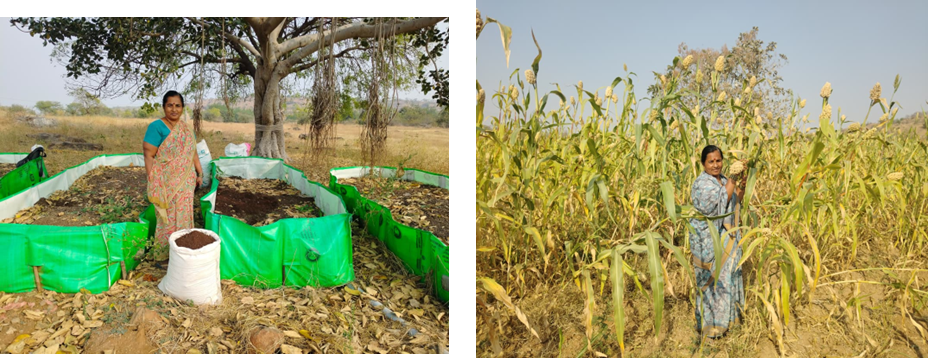
However, the situation is slowly changing. Many women are now reclaiming their place in agriculture and taking more active roles as farmers and decision-makers. One such inspiring woman farmer is Mahananda Huccheshwar Kumbhar from Diksal village in Sangola block of Solapur district, Maharashtra.
This success story comes from the Comprehensive Village Development Programme (CVDP), implemented by the Centre for Youth Development and Activities (CYDA) with financial support from SBI Mutual Fund. The programme encourages young farmers to adopt sustainable and low-cost farming practices.
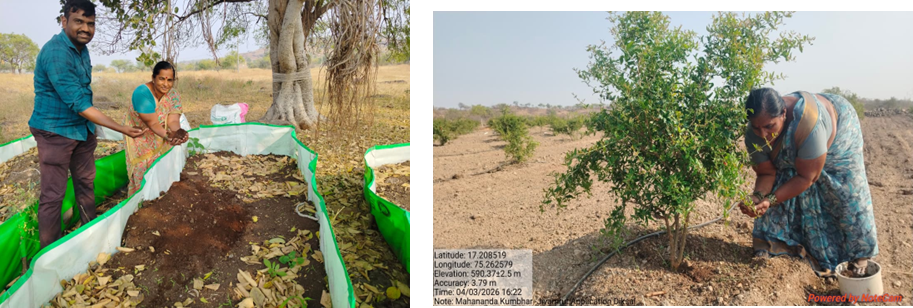
Ms Mahananda owns 4.5 acres of land and lives with her family of four. Out of this land, 1.25 acres are under pomegranate cultivation, where she maintains around 420 healthy plants. She also grows wheat, chickpea, and jowar.
Still her life was challenging. Like many farmers in drought-prone Sangola, she depended purely on chemical fertilisers and sprays. For one acre alone, she used 2–3 bags of chemical fertilisers every season, costing around Rs. 3,000/- to Rs. 4,000/-. This did not include the cost of chemical sprays and micronutrients. Slowly, the cost of farming kept increasing. At the same time, the soil was losing its natural fertility. Even though crops were growing, profits were decreasing. She felt worried and helpless. Farming was becoming expensive, and she feared for her family’s future. During the period of financial stress, she felt worried because she had to spend around Rs. 10,000/- per crop in a season on agricultural inputs such as fertilisers, pesticides and other expenses. Managing these costs each season was difficult for her and put financial pressure on the household, leaving her unsure whether she could sustain farming activities. Despite the financial challenges and uncertainties, she did not give up; in fact, she continued her farming activities with patience and confidence.
The turning point came when CYDA introduced vermicomposting. With support and guidance, she received four vermicompost beds and 12 kgs of earthworms. She learnt how to prepare organic manure on her own farm. With courage and determination, she gradually stopped using chemical fertilisers, sprays, and weedkillers. Her family supported her decision to stop using chemical inputs.
Today, she follows organic farming practices. She produces around 3 tons of vermicompost and uses it in her pomegranate orchard and in other crops such as wheat, chickpea, and jowar. She also uses bio-slurry and farmyard manure (FYM). Recently, she began cultivating Sunn hemp (Crotalaria juncea), locally known as Tag, as a fodder crop and green manure. The use of Sunn hemp has further improved soil fertility. She has now started applying vermicompost in the Taag (Sunn hemp) crop to improve soil fertility and crop growth.
The results have been very encouraging. Her input costs have reduced significantly. The soil is healthier and more fertile. The crops appear stronger and greener. The plants display good foliage, and the overall field condition has improved, indicating positive outcomes from her current farming practices. Most importantly, she has gained confidence and peace of mind.
“Earlier, I depended on costly chemicals, but today my farm produces its own manure. Vermicomposting has given me confidence, healthier soil, and hope for a better future.” – Mahananda Kumbhar.
Mahananda’s farm is now a model of sustainable, low-cost agriculture in her village. Once reliant on expensive chemicals, she became self-sufficient through vermicomposting. Inspired by her success, local farmers have begun practising vermicomposting to boost soil health and cut input costs. She actively guides others, sharing firsthand experience and clearly outlining the benefits of vermicomposting and organic methods, motivating more farmers to adopt these techniques.
Now, Mahananda has clear plans for the future. She wants to start marketing vermicompost and bio-slurry to farmers in nearby villages. By selling these organic inputs, she hopes to encourage more farmers to adopt organic and sustainable farming practices. This will not only support healthier farming but also create an additional source of income for her family. Mahananda is also planning to expand vermicompost production in the coming years. Her journey shows how women farmers are slowly moving from being farm workers to becoming independent farmers and rural entrepreneurs, creating new opportunities for themselves and their communities.
