Dr. Kuldeepsingh Rajput
Every year, hundreds of Korku tribal families from different tribal villages in Jalgaon-Jamod block of Buldhana district in Maharashtra migrate seasonally to brick-kilns in search of livelihood. Declining agricultural incomes, limited irrigation, and the absence of local employment opportunities have made brick-kilns a major survival destination for Korku tribal households. Entire families migrate together, including young children. The seasonal mobility of this precarious tribal labour force adversely affects accompanying children at multiple levels. One of the most significant vulnerabilities faced by migrant children is their systematic exclusion from their constitutional Right to Education (RTE), which in turn shapes their future educational trajectories, career prospects, and broader well-being (Rajan & Rajput, 2023). For these tribal children, migration is not merely physical movement; it signifies disconnection from schooling, stability, and childhood. Global evidence has repeatedly shown that children from migrant and mobile populations are among the most educationally excluded groups (UNICEF 2019; UNESCO 2018).
Living conditions at brick-kiln sites are harsh. Families reside in temporary shelters without access to safe drinking water, sanitation, anganwadis, or schools. Children spend long hours accompanying parents at worksites, caring for siblings, or playing near hazardous brick-moulding and firing zones. Months of school absence lead to learning loss, grade repetition, and eventually permanent dropout patterns widely documented in studies on seasonal migrant children in India (UNICEF India, 2020; National Commission for Protection of Child Rights, 2018). For many Korku children, this cycle repeats annually, gradually pushing them out of the education system and into child labour.
Recognising this persistent yet largely invisible crisis, the RUBAL Foundation initiated the ‘RUBAL Jidnasa Centre’, an education support centre at a brick-kiln site to create a safe and supportive learning space for migrant Korku children. The Centre was inaugurated on 14 January 2026 by Professor Prashant Bansode of Gokhale Institute of Politics and Economics, (Pune) in the presence of tribal leaders, migrant workers, and the brick-kiln owner reflecting shared responsibility among communities, civil society, and employers. This initiative also resonates with the spirit of the Right to Education Act (2009) and National Education Policy (2020), which emphasise inclusion of disadvantaged and mobile children.
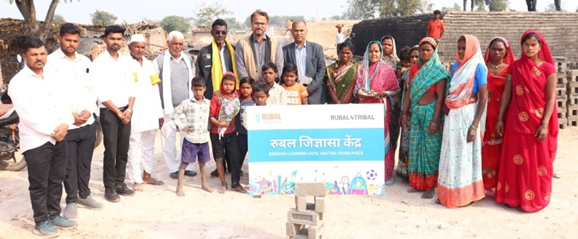
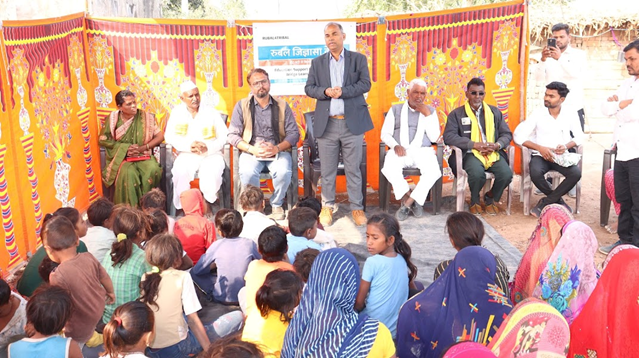
RUBAL’s Education Centre at the Brick-Kiln
RUBAL’s field engagement in Korku tribe villages shows that seasonal migration is a well-established and distress-driven practice. Most households are small and marginal farmers or landless labourers facing chronic debt, crop failures, alcoholism, low literacy, and uncertain incomes. With limited irrigation and few non-farm opportunities, migration during the agricultural lean season becomes a survival strategy rather than a choice. Families migrate with their children, who depend on parental care. Consequently, education becomes secondary to livelihood. Schooling is irregular or suspended for several months each year.
Through community meetings and field observations, we at the RUBAL found no systematic mechanism for tracking migrant families or coordinating between source villages and destination worksites. Migrant children remain invisible to education departments and social protection systems. They are neither retained in schools at source nor integrated at destination. This institutional gap has persisted for decades, reproducing intergenerational educational exclusion. The Jidnasa Centre emerged as a response to this vacuum, seeking to ensure that migration does not completely sever children’s relationship with learning.
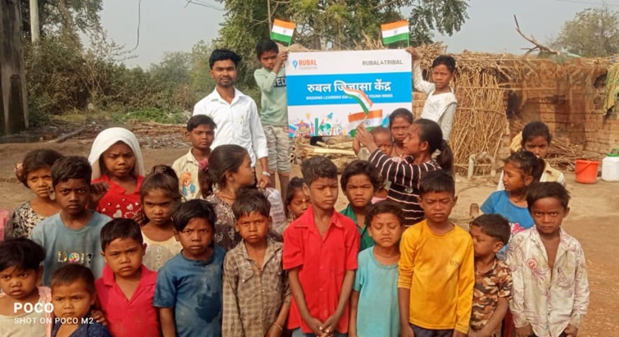
RUBAL Jidnasa Centre is a community-based learning space located directly at the brick-kiln where Korku families live and work. It operates for a few hours each day and caters to children between 6 and 14 years of age. Currently, 32 migrant children are regularly learning at the brick-kiln site, demonstrating that even within conditions of extreme precarity, education can be made accessible. The Centre focuses on strengthening foundational literacy and basic numeracy, while also using storytelling, songs, drawing, and activity-based methods to make learning engaging. Play-based and child-friendly approaches form the core of its pedagogy, creating a supportive environment where children feel safe, motivated, and confident to learn.
Mainstream education assumes regular schooling from a fixed location an assumption that collapses under migration. The Jidnasa Centre reverses this logic by taking education to where the child is.Parents repeatedly expressed relief that their children are now engaged in learning rather than spending the entire day at worksites. As one mother shared, “Earlier our children used to roam around the kiln or come with us to work. Now they go to the Jidnasa Centre daily. We feel happy that they are learning something and not becoming labourers like us.”
A father echoed this sentiment, saying, “We migrate every year and school always stops. Because of this centre, my daughter is still connected to studies. At least her education has not completely broken.” Another mother added, “Earlier we thought small children cannot study here. Now we see they can learn even at the kiln. We are relieved that their time is spent in learning, not in work.”
We at the RUBAL are documenting children’s age, village, and previous school enrolment to support re-enrolment upon return migration. The aim is to prevent children from starting from zero after each migration cycle and to ease reintegration into formal schooling.
A Small Centre, A Larger Message
The Jidnasa Centre is a modest and small initiative, but its message is powerful. Currently, 32 migrant children attend learning sessions regularly at the brick-kiln site, showing that education can reach children even in highly precarious settings. Seasonal migrant children continue to remain largely absent from education planning and official data systems, as their mobility is treated as an exception rather than a structural reality. This intervention shows that education must adapt to children’s mobility that flexible and community-based learning spaces are essential, and that foundational learning during migration is both possible and effective. Building on this experience, RUBAL plans to replicate the Jidnasa Centre model across more brick-kiln sites, strengthen educator training, develop contextual learning materials, improve coordination with village schools, and advocate for migrant-sensitive education policies. Support from donors, CSR initiatives, and philanthropic organisations will be crucial to sustain and scale such child-centred interventions for migrant communities.
References
Government of India. (2009). The Right of Children to Free and Compulsory Education Act, 2009. Ministry of Law and Justice.
Ministry of Education, Government of India. (2020). National Education Policy 2020. Government of India.
National Commission for Protection of Child Rights (NCPCR). (2018). Education of children of migrant labourers in India. Government of India.
Rajan, S. I., & Rajput, K. (2023, June 5). Right to education of migrating children in India. World Bank Blogs.
UNESCO. (2018). Global education monitoring report 2019: Migration, displacement and education – Building bridges, not walls. UNESCO Publishing.
UNICEF. (2019). India: Education of migrant children. United Nations Children’s Fund.
UNICEF India. (2020). Children on the move in India: Understanding the scale, patterns and vulnerabilities. United Nations Children’s Fund, India Country Office.
Dr. Kuldeepsingh Rajput is a development practitioner and migration scholar. He leads the RUBAL Foundation, a non-profit organisation working with migrants, informal workers, and rural and tribal communities.
